Articles & Wisdom

Philosophical Reflections

Explore articles, commentaries, and practical reflections illuminating ancient wisdom for everyday living.

Curated Reads

Featured Articles

43 articles
All Publications

Latest Articles

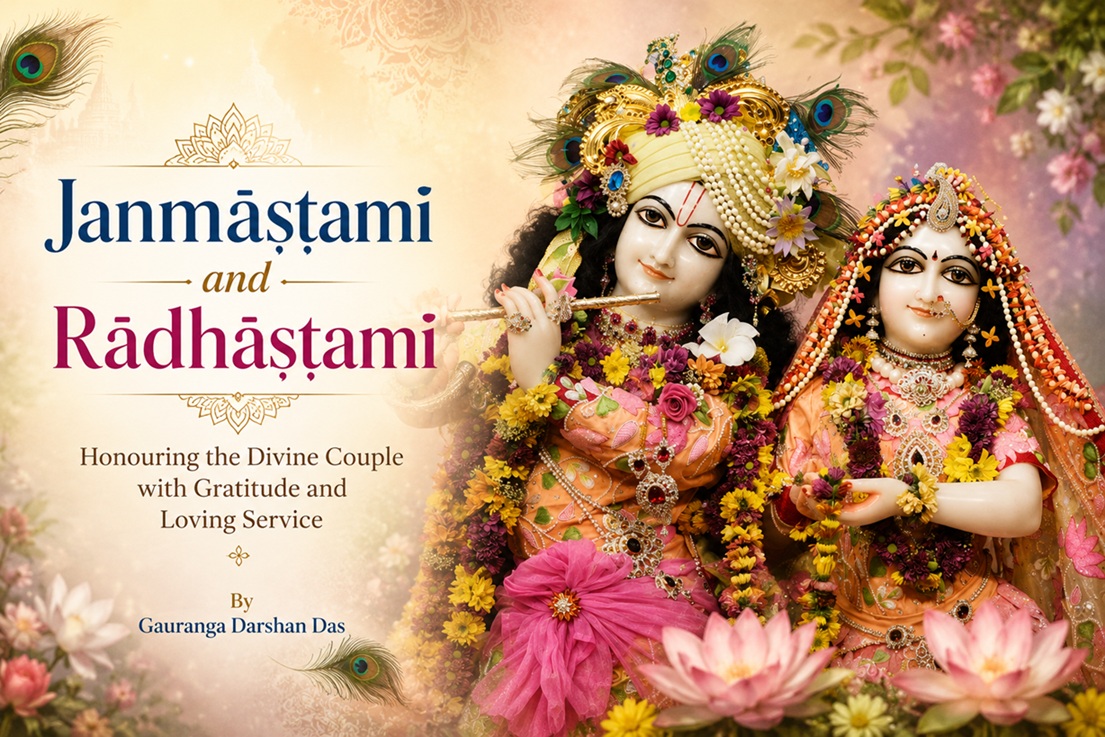
Janmāṣṭamī and Rādhāṣṭamī: Honouring the Divine Couple with Gratitude and Loving Service
Every year, devotees across the world joyfully celebrate two of the most cherished festivals in the Vaiṣṇava calendar—Śrī Kṛṣṇa Janmāṣṭamī and Śrī Rādhāṣṭamī, the auspicious appearance days of Śrī Kṛṣṇa and Śrīmatī Rādhārāṇī. Temples adorned with flowers and sparkling decorations resound with melodious kīrtanas and hari-kathā as devotees celebrate these sacred occasions through worship, chanting, dancing, fasting and feasting. Yet these festivals are far more than annual commemorations of two divine appearance days. Together, they reveal the heart of Gauḍīya Vaiṣṇava theology. Kṛṣṇa is the supreme object of love, while Śrīmatī Rādhārāṇī is the supreme embodiment of love for Him. Kṛṣṇa enchants the entire universe (jagan-mohana), yet Śrī Rādhā enchants even Kṛṣṇa Himself (jagan-mano-mohana-citta-mohinī). Janmāṣṭamī invites us to meditate on Śrī Kṛṣṇa's unlimited beauty, sweetness and compassion, while Rādhāṣṭamī invites us to contemplate on Śrīmatī Rādhārāṇī's unparalleled devotion and seek Her blessings to develop sincere devotion for Kṛṣṇa. In truth, these two appearances are inseparable, complementary manifestations of divine compassion. Kṛṣṇa appears to bestow His association upon the conditioned souls and delight His eternal devotees with His enchanting pastimes. Śrīmatī Rādhārāṇī appears to reveal the supreme glory of selfless, pure devotion to Kṛṣṇa. We are eternal aṁśas of Kṛṣṇa (Bhagavad-gītā 15.7), and whatever devotion awakens within our hearts is but a tiny aṁśa of Śrīmatī Rādhārāṇī's limitless devotion, bestowed upon us by Her causeless mercy. The Compassion Behind Kṛṣṇa's Descent The circumstances of Kṛṣṇa's appearance beautifully reveal both His majesty and His sweetness. He first appeared before Vasudeva and Devakī in the prison of Kaṁsa in His majestic four-armed form, inspiring them to offer heartfelt prayers in awe and reverence. By His inconceivable potency, He simultaneously manifested in Gokula as the beloved son of Nanda Mahārāja and Mother Yaśodā. Thus, in Mathurā He revealed His aiśvarya, or divine majesty, while in Vraja He revealed His incomparable mādhurya, His intimate sweetness. Unlike ordinary living beings, Lord Kṛṣṇa does not appear under the force of karma. His appearance is entirely transcendental, arising solely from His own independent will. Therefore, He declares in the Bhagavad-gītā: janma karma ca me divyam evaṁ yo vetti tattvataḥtyaktvā dehaṁ punar janma naiti mām eti so 'rjuna "One who knows the transcendental nature of My appearance and activities does not, upon leaving the body, take birth again in this material world, but attains My eternal abode, O Arjuna." (Bhagavad-gītā 4.9) The Lord descends to protect His devotees, curb the influence of the wicked and re-establish the principles of dharma. Yet beyond these well-known purposes lies an even more intimate reason for His appearance—to reciprocate with the love of His devotees. His descent is not merely a divine intervention in history but an invitation to every soul to revive its eternal relationship of loving reciprocation with Him. Śukadeva Gosvāmī beautifully reveals this confidential purpose: anugrahāya bhaktānāṁ manuṣaṁ deham āśritaḥbhajate tādṛśīḥ krīḍā yāḥ śrutvā tat-paro bhavet "To bestow His mercy upon His devotees, the Supreme Lord accepts a humanlike form and performs such wonderful pastimes that anyone who hears about them becomes devoted to Him." (Śrīmad-Bhāgavatam 10.33.36) Kṛṣṇa appears not merely to demonstrate His supremacy but to reveal His affection through His enchanting pastimes with His pure-hearted devotees, especially the residents of Vṛndāvana. There He lovingly reciprocates in the mellows of servitorship, friendship, parental affection and conjugal love. Although He is the all-powerful Supreme Lord, He willingly becomes conquered by the love of His devotees (bhaktair jitatvam). In doing so, He proclaims the unparalleled glory of bhakti, the supreme spiritual path that reconnects the eternal soul with its beloved Lord. Janmāṣṭamī thus offers us an opportunity to meditate deeply on Kṛṣṇa's boundless compassion. Although we have forgotten Him for countless lifetimes and become entangled in material existence, He has never forgotten us, rather accompanies us as the Supersoul within our hearts, patiently guiding us, witnessing our struggles, and waiting for the day we voluntarily turn toward Him. Out of His causeless mercy, He descends into this world, performs captivating pastimes, speaks timeless wisdom through the Bhagavad-gītā, and sends His pure devotees and scriptures to repeatedly remind us of our eternal relationship with Him. His desire is not to punish the conditioned souls but to reclaim them with love. Therefore, Janmāṣṭamī is much more than a celebration of Kṛṣṇa's appearance in Mathurā over five thousand years ago. It is an opportunity to pause and reflect upon His unending efforts to bring us back to Him. As we gaze upon the beautiful Deities, hear the narrations of His divine pastimes and chant His holy names, our hearts can naturally respond with gratitude. We may pray, "My dear Lord Kṛṣṇa, You descended from Your eternal abode solely to bestow Your mercy upon us. You performed enchanting pastimes to attract our hearts, spoke the Bhagavad-gītā to guide us, and continue to reach out to us through Your empowered devotees. Please help me recognise Your compassion, respond to Your loving invitation, and dedicate my life more sincerely to the path of bhakti." The Lord's appearance in the dark prison of Kaṁsa is also deeply symbolic. Just as His presence immediately dispelled the darkness of that prison, His presence in our hearts dispels the darkness of ignorance, fear and material attachment. When we sincerely invite Kṛṣṇa into our lives through devotional service, He gradually transforms our consciousness, replacing despair with hope, confusion with wisdom, and material anxiety with the joy of loving service. And the highest expression of that loving service is personified by Śrīmatī Rādhārāṇī. If Kṛṣṇa's compassion inspires us to dedicate our lives to Him, Śrīmatī Rādhārāṇī's spotless devotion inspires and empowers us to love Him in the purest possible way. It is to Her sublime example and boundless mercy that we now turn. The Gift of Śrīmatī Rādhārāṇī's Appearance Rādhāṣṭamī invites us to marvel at the unsurpassed glory of the one who loves Kṛṣṇa the most. Just as the flower and its fragrance are inseparable, Śrī Śrī Rādhā and Kṛṣṇa are eternally united, together revealing the complete truth of divine love. Śrīmatī Rādhārāṇī manifested in the home of King Vṛṣabhānu and Queen Kīrtidā in the sacred land of Vraja. Although She appeared as an exquisitely beautiful child, She kept Her eyes closed from birth. When Mother Yaśodā visited with baby Kṛṣṇa in Her arms, Rādhārāṇī opened Her eyes for the very first time, beholding His enchanting face. This cherished pastime beautifully conveys that Her entire existence is meant for Kṛṣṇa. Every aspect of Her being is dedicated to His service, His pleasure, and His glory. For this reason, Śrīla Kṛṣṇadāsa Kavirāja Gosvāmī introduces Śrīmatī Rādhārāṇī with one of the most profound descriptions: devī kṛṣṇa-mayī proktā rādhikā para-devatā (Caitanya-caritāmṛta, Ādi-līlā 4.83). The expression kṛṣṇa-mayī means "completely pervaded by Kṛṣṇa" or "filled with Kṛṣṇa." It signifies far more than constant remembrance of Kṛṣṇa. Every faculty of Śrīmatī Rādhārāṇī's being exists solely for Him. Her eyes delight in beholding His beautiful form, Her ears rejoice in hearing His names and pastimes, Her voice finds fulfilment in glorifying Him, and Her hands eagerly engage in His service. Her intelligence seeks only what will increase His happiness, and Her heart knows no desire apart from His pleasure. Even Her slightest smile, glance or movement exists only to bring joy to Kṛṣṇa. Ordinary devotion often begins with our own needs. We approach the Lord seeking happiness, protection, guidance or purification. Śrīmatī Rādhārāṇī's love, however, is entirely selfless. Her only concern is Kṛṣṇa's happiness, and His happiness is Her life's fulfilment. Thus, She is not merely the greatest devotee of Kṛṣṇa but the very personification of pure devotion. Kṛṣṇa is the perfection of the Absolute Truth, while Śrīmatī Rādhārāṇī is the perfection of devotion to that Absolute Truth. Although we can never imitate Her devotion, we can seek Her shelter and pray for even a particle of Her selfless mood. Whatever devotion awakens within our own hearts is but a tiny reflection of Her limitless love. Indeed, Lord Kṛṣṇa Himself explains that genuine devotees are sheltered by His divine internal energy: mahātmānas tu māṁ pārtha daivīṁ prakṛtim āśritāḥbhajanty ananya-manaso jñātvā bhūtādim avyayam "O son of Pṛthā, those who are not deluded, the great souls, are under the protection of the divine nature. They are fully engaged in devotional service because they know Me as the Supreme Personality of Godhead, original and inexhaustible." (Bhagavad-gītā 9.13) Śrīla Prabhupāda explains: "In the above-quoted verse from Bhagavad-gītā, the words daivīṁ prakṛtim refer to the control of the internal potency, or pleasure potency, of the Supreme Personality of Godhead. This pleasure potency is manifested as Śrīmatī Rādhārāṇī, or Her expansion Lakṣmī, the goddess of fortune. When the individual jīva souls are under the control of the internal energy, their only engagement is the satisfaction of Kṛṣṇa, or Viṣṇu. This is the position of a mahātmā." (Nectar of Instruction 2) Thus, genuine devotion to Kṛṣṇa flourishes under Śrīmatī Rādhārāṇī's compassionate shelter. We approach Kṛṣṇa most naturally and most successfully by taking shelter of the one who loves Him perfectly. With this understanding, we celebrate Rādhāṣṭamī not merely as the appearance day of an exalted devotee but as the advent of the Supreme Goddess of Devotion, who nourishes our relationship with Kṛṣṇa. By glorifying and worshipping Her, we pray to replace self-interest with selfless service, and material expectations with wholehearted dedication to Kṛṣṇa's satisfaction. The true significance of Rādhāṣṭamī, therefore, is not simply to admire Śrīmatī Rādhārāṇī's devotion but to pray for a drop of it. As we sincerely seek Her shelter, our hearts gradually become reoriented toward Kṛṣṇa's happiness rather than our own, allowing us, however faintly, to understand the profound meaning of becoming kṛṣṇa-maya. Janmāṣṭamī reveals the all-attractive Lord, while Rādhāṣṭamī reveals the supreme embodiment of love whose devotion captivates even Him. Together they unveil the complete science of bhakti, teaching us not only whom to love, but also how to love Him. Honouring the Divine Couple in Our Lives The festivals of Janmāṣṭamī and Rādhāṣṭamī are not merely occasions for remembering sacred events of the past. They are invitations to transform our devotional lives. Janmāṣṭamī reminds us that the Supreme Lord is not an impersonal force or a distant ruler beyond the reach of His devotees. He is the all-attractive Śrī Kṛṣṇa, whose beauty captivates every heart and whose compassion draws even the most fallen souls toward Him. Rādhāṣṭamī, in turn, reveals the spirit in which the loving invitation from Kṛṣṇa is to be accepted. Śrīmatī Rādhārāṇī demonstrates that the essence of devotion lies not in what we receive from Kṛṣṇa, but in seeking His happiness. Her spotless devotion reveals the perfection of selfless love. As Śrīla Kṛṣṇadāsa Kavirāja Gosvāmī explains: ātmendriya-prīti-vāñchā—tāre bali 'kāma'kṛṣṇendriya-prīti-icchā dhare 'prema' nāma "The desire to gratify one's own senses is called kāma (lust), whereas the desire to please the senses of Lord Kṛṣṇa is called prema (love)." (Caitanya-caritāmṛta, Ādi-līlā 4.165) This profound teaching has practical implications for every devotee. Love naturally expresses itself through service with pure intention. Whether offering a flower, worshipping the Deities, chanting the holy names, serving the Vaiṣṇavas, or performing the smallest task, every act becomes spiritually beautiful when done solely for Kṛṣṇa's pleasure. Cleanliness in the temple, attentiveness in worship, punctuality in service, and sincerity in our dealings are not mere disciplines—they are expressions of love. Another hallmark of Śrīmatī Rādhārāṇī's devotion is complete freedom from selfishness. This same spirit shines throughout Vṛndāvana. The Vrajavāsīs rejoice whenever Kṛṣṇa is pleased, regardless of who receives the opportunity to serve Him. Their happiness lies not in personal recognition but in His satisfaction. As we learn to celebrate Kṛṣṇa's pleasure above our own prestige and preferences, our hearts become purified and our devotion deepens. Ultimately, Rādhāṣṭamī invites us to become, in our own small measure, kṛṣṇa-maya. We can never imitate Śrīmatī Rādhārāṇī's limitless love, yet we can sincerely aspire to follow Her example. Spiritual advancement is nothing but the gradual reorientation of our lives toward Kṛṣṇa. Little by little, our thoughts, words and actions become centred on His pleasure. Śrīla Rūpa Gosvāmī beautifully describes the transformation that takes place in the heart of one whose life becomes absorbed in Kṛṣṇa: nāmāni praṇayena te sukṛtināṁ tanvanti tuṇḍotsavaṁdhāmāni prathayanti hanta jalada-śyāmāni netrāñjanamsāmāni śruti-śaṣkulīm muralikā-jātāny alaṅkurvatekāmānīvṛta-cetasām iha vibho nāśāpi naḥ śobhate "Now that we have become Your devotees, Your holy names have affectionately created a jubilant festival in our mouths. Your bodily splendour, like a dark raincloud, has become the black ointment of our eyes, and the music of Your flute has become the ornament of our ears. We no longer take pleasure in material things. O Almighty Lord, material pleasures no longer appear beautiful to us."(Padyāvalī 59) When the heart becomes absorbed in Kṛṣṇa, His holy names become a festival for the tongue, His beautiful form becomes the ointment for the eyes, and the sound of His flute becomes the ornament of the ears. Material attractions eventually lose their hold, not through forced renunciation, but because one has discovered a higher taste. Such is the transformation inspired by the mercy of Śrīmatī Rādhārāṇī. The Gauḍīya Vaiṣṇava tradition reaches its most beautiful culmination in the appearance of Śrī Caitanya Mahāprabhu. Śrīla Kṛṣṇadāsa Kavirāja Gosvāmī explains that Śrī Caitanya is none other than Śrī Śrī Rādhā-Kṛṣṇa united in one form: rādhā-kṛṣṇa-praṇaya-vikṛtir hlādinī-śaktir asmādekātmānāv api bhuvi purā deha-bhedaṁ gatau taucaitanyākhyaṁ prakaṭam adhunā tad-dvayaṁ caikyam āptaṁrādhā-bhāva-dyuti-suvalitaṁ naumi kṛṣṇa-svarūpam (Caitanya-caritāmṛta, Ādi-līlā 1.5) Although Śrī Rādhā and Kṛṣṇa are eternally one, They manifested as two to relish the sweetness of Their loving exchanges. Later, They appeared as one again in the form of Śrī Caitanya Mahāprabhu, with Kṛṣṇa accepting the mood and golden complexion of Śrīmatī Rādhārāṇī in order to experience the glory of Her love for Him. Yet He did not come merely to relish that love Himself. He came to distribute it freely through the congregational chanting of the holy names. Recognising this unparalleled compassion, Śrīla Rūpa Gosvāmī offered his celebrated prayer: namo mahā-vadānyāyakṛṣṇa-prema-pradāya tekṛṣṇāya kṛṣṇa-caitanya-nāmne gaura-tviṣe namaḥ "I offer my respectful obeisances unto the most munificent incarnation, Śrī Kṛṣṇa Caitanya, who is Kṛṣṇa Himself appearing with a golden complexion to freely bestow love of Kṛṣṇa." Thus, the celebrations of Janmāṣṭamī and Rādhāṣṭamī naturally lead us to the lotus feet of Śrī Caitanya Mahāprabhu. Janmāṣṭamī reveals the Supreme Beloved. Rādhāṣṭamī reveals the supreme embodiment of love for that Beloved. And Śrī Caitanya Mahāprabhu reveals that this divine love is not reserved for a select few, but is freely offered to every sincere soul. As we celebrate these sacred festivals, may Janmāṣṭamī deepen our appreciation for Śrī Kṛṣṇa, may Rādhāṣṭamī awaken within us a longing to follow the spotless devotion of Śrīmatī Rādhārāṇī, and may the causeless mercy of Śrī Caitanya Mahāprabhu and His followers purify our hearts so that every thought, every word and every action may be offered for the pleasure of Śrī Śrī Rādhā-Kṛṣṇa. For the true purpose of honouring the Divine Couple is not merely to celebrate Their appearance with flowers, songs and festivals, but to allow Their divine love to reshape our hearts. As we honour Janmāṣṭamī and Rādhāṣṭamī year after year, may we gradually learn to love Kṛṣṇa under the compassionate guidance of Śrīmatī Rādhārāṇī. Then Janmāṣṭamī and Rādhāṣṭamī will no longer be merely annual festivals; they will become the guiding inspiration of our lifelong practice of bhakti. Gaurāṅga Darśana Dāsa, a disciple of His Holiness Rādhānāth Swami, is dean of Govardhan School of Education and Culture at ISKCON GEV. He is the author of fifty-three books, including the Subodhini series of study guides, children’s books such as Bhāgavatam Tales, and other self-enrichment books. He offers online and residential scriptural courses for adults and children worldwide.
Sep 3, 2026 457
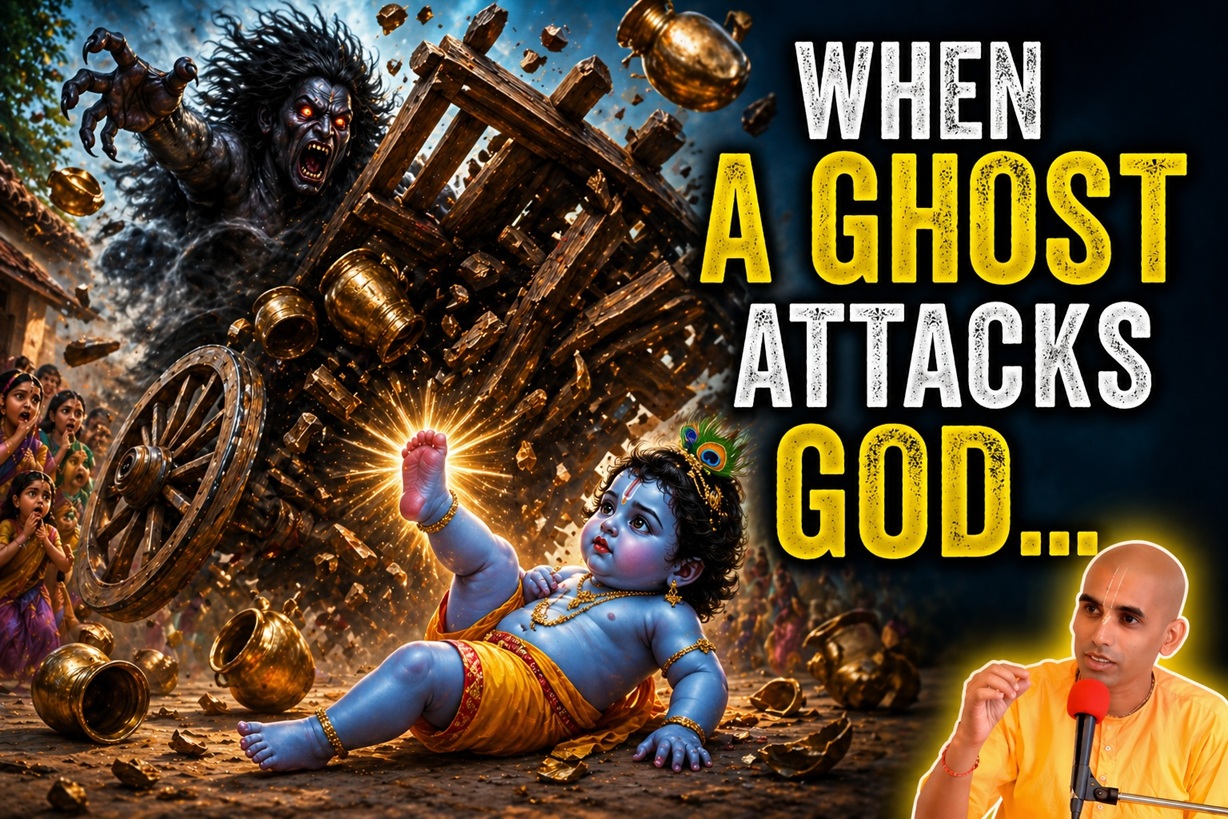
When a ghost attacks god…
Ghosts do not have gross bodies. But they do have subtle bodies. Gross bodies are made of earth, water, fire, air, and ether. Subtle bodies are made of mind, intelligence, and ego. Both of these bodies are material and all individuals in this world are covered by these two types of bodies. Subtle bodies store all kinds of desires and past impressions that induce the actions of gross bodies. People who are too sinful cannot get a gross body but roam around invisibly in subtle bodies with unfulfilled desires. Such body-less beings are called ghosts. Sometimes ghosts try to fulfill their desires by possessing the bodies of common people. Or they enter some gross objects to execute their evil plans. Here is the story of one such ghost inspired by a malicious thought to kill God who was in the form of a baby.   Pride Made Him A Ghost Utkaca was the son of a great demon named Hiranyaksa. He had a huge body and was very powerful. Any material good quality could potentially induce false pride in a person to a small or great extent. So Utkaca was also proud of his strength. Once Utkaca went to the hermitage of a sage named Lomasa, who had studied a hundred lessons in morality from Lord Brahma. For no reason, Utkaca started breaking trees there, being puffed up of his strong body. Seeing him creating an unnecessary disturbance, sage Lomasa cursed him, “O evil-hearted one, become bodyless!” Utkaca’s body at once fell away like a snake’s old skin falls away. He became a ghostly being without a body (some say that he got an invisible body made of air). Such is the result of material pride and offense to saintly persons. Utkaca realized his mistake, fell at Lomasa’s feet, and begged him, “O great sage, I did not know your power. Please forgive me and give me a body.” Lomasa became pacified quickly and said, “Lord Krishna’s foot will liberate you from this ghostly existence.” Saintly devotees have the power both to curse and bless. Even the anger of saintly persons is a blessing. Because of Lomasa’s curse, Utkaca would be getting an opportunity to be touched by the divine lotus foot of the Supreme God Krishna.   Fear Haunted Him Like A Ghost Later Utkaca, wandering as a ghost, made friends with another demoniac person named Kamsa. Kamsa was the cruel maternal uncle of Lord Krishna. He was madly in search of baby Krishna because he had once heard an omen that he would be killed by the eighth son of his sister Devaki, who was Lord Krishna Himself. Fear of death, haunting him like a ghost, Kamsa was always immersed in the thoughts of Krishna and tried to search for Krishna. He became completely Krishna conscious, not with devotion, but with intense fear. Interestingly, even such fearful remembrance of Krishna, when it leads to complete absorption in Krishna , can liberate a person. That is Krishna’s special mercy on demons. Kamsa dispatched many of his demoniac friends to find and kill the Lord, his future killer! Instigated by Kamsa, Utkaca also came to Gokula to kill Krishna, who then was a three months old baby. The demon (asura) entered a household cart (Sakata) in Nanda Maharaja’s courtyard. The cart was loaded with many vessels made of gold, silver, and brass. In Sanskrit, a cart is called Sakata and a demon is called asura. Therefore, Utkaca was also called Sakatasura – the cart demon. No one noticed Sakatasura as he was invisible. He waited for an opportunity to kill Krishna.   A Ceremony Led By Women When Krishna was just three months old, He attempted to rise and turn around on His own for the first time. This stage of a child’s growth was celebrated as the Utthana ceremony. In the Vedic culture, a child’s birth or maintenance was never a burden for the parents, who joyfully celebrated all the significant stages of a child’s growth. Certain purificatory rituals were performed even before conceiving the child and when the child was in the mother’s womb. The birth ceremony was an event led by the father. Utthana ceremony was an event led by mothers. Krishna’s birth was celebrated by Nanda Maharaja as Nandotsava with the assistance of Mother Yasoda. Utthana ceremony was celebrated by Yasoda with the assistance of Nanda. In a cultured society, mother and father have specific roles to play in raising the child with cooperation from each other. Such balanced care of parents nourishes and ensures the child’s physical and emotional development.  Mother Yasoda led the Utthana ceremony on the auspicious day when the moon was in Rohini constellation which was also Krishna’s birth star. Being an expert in all ceremonies, Yasoda did abhiseka (holy bathing) of Krishna assisted by other motherly gopis of Gokula. After completing the bathing ceremony, Krishna was rubbed dry by Yasoda and the gopis and He was anointed with gorocana (an aromatic medicinal substance obtained from a cow) and dressed up nicely. Yasoda received the brahmanas carrying her blue boy dressed in red garments and decorated with golden ornaments. Krishna’s lotus eyes were decorated with black ointment and He wore a glittering moon necklace made of lion nail. Yasoda offered respects to the devatas. She liberally distributed grains, wealth, clothes, flowers, and cows in charity to the brahmanas, who chanted mantras to invoke auspiciousness.   Body-less Ghost Attains a Spiritual Body At that time, little Krishna felt sleepy. So, Yasoda carried Him to the courtyard. Being an affectionate mother, anxious for her child’s comfort, she carefully held Him motionlessly in her lap fearing that He would wake up. She made Krishna lay down under the household cart (Sakata) in which ghost Utkaca had entered. She also lay down along with the child until He was asleep. When she saw that Krishna was fast asleep, she got up very gently and went back to attend the guests. Some small children who were playing around saw Krishna peacefully sleeping. Because of Sakatasura, the wheels of the cart began to sink into the earth and the cart’s height started decreasing. Sakatasura intended to fall on Krishna and kill Him. But baby Krishna got up from His sleep. Absorbed in the mood of an infant, He began crying for mother’s milk. Yasoda was busy exchanging pleasantries and giving ornaments, garlands, sandalwood pulp (candana), oil and sindhura to the village women. Therefore, she couldn’t hear the child crying from hunger. As it is natural for babies, Krishna angrily threw His little legs upward in the air. The red sole of Krishna’s soft foot touched the cart with the gesture of a kick. Although Krishna’s foot was as tender as a newly grown leaf, His kick turned the cart upside down. His limbs were inconceivably potent, the cart got dismantled completely; its wheels and axle were dislocated; its handle was broken and all the utensils on it were scattered here and there. Thus, the demon in the cart died. Sakatasura had entered the cart invisibly and was destroyed invisibly. No one had noticed him. But the children saw that Krishna kicked the cart which then overturned. When the cart broke into pieces, Sakatasura left his subtle ghostly body and attained a pure spiritual body. He respectfully bowed down before Lord Krishna. In a chariot pulled by a hundred horses, he went to Krishna’s abode of Goloka Vrndavana in the spiritual world. Such is the mercy of the Supreme Lord Krishna, especially in Vrndavana. Sakatasura represents a load-carrying mentality arising out of old and new bad habits, from this life and previous lives. These habits include lethargy, dullness, and false pride. Krishna removes this contamination by kicking them aside when we take His shelter by performing bhakti.   Krishna’s Uncompromising Sweetness Krishna didn’t manifest a gigantic form or use any weapons to kill Sakatasura. Just the kick of an infant baby was sufficient. This is the sweetness of Krishna’s childhood pastimes. To subdue King Bali, Lord Vamana manifested His TrivikRama form and extended His foot to the greatest height to penetrate the covering of the universe. To kill gigantic Hiranyakasipu, the Lord assumed the special body of Nrsimhadeva. In other incarnations, the Lord had to exert some energy according to the time and circumstances. But as Krishna, He exhibited unlimited potency without compromising His form and mood as a child. Krishna’s loving dealings with His mother, father, and friends in Gokula were a priority for Him and the death of demons happened as a byproduct. The dead demons were delivered from their degraded life and attained better destinations or even spiritual liberation. Krishna wanted the attention of His mother when He woke up from His sleep. Because the sound of His crying didn’t catch Yasoda’s attention, He seemed to make a louder sound by kicking the cart and thus calling His mother there at once. As a result, Sakatasura also died! This rare display of the power of Krishna which does not contradict the sweetness of His childhood pastimes shows the completeness of Krishna. Lord Rama showed only human-like pastimes during His childhood. Krishna, however, showed his powers in harmony with his sweet human-like pastimes.   Love Covers Logic Everyone saw the dismantled cart and wondered, “How did the cart turn over by itself?” But the children who were looking at Krishna attracted by His sweetness, asserted, “Krishna kicked the cart and it fell.” But the elders neglected the childish talk thinking, “How could the kick of a three-month-old baby overturn such a heavily loaded cart!” An ordinary child could have been injured in many ways, but Krishna enjoyed the dismantling of the cart and was safe. The gopas and gopis thought that the accident took place because of the bad influence of some planet or some ghost. The cowherd community was always accustomed to seeing Krishna as their beloved child and object of their affection, and not as God with powers. This time the elders didn’t see Krishna’s powers. But in the later pastimes, they saw Krishna manifesting His opulence right in front of their eyes when He subdued Kaliya, swallowed forest fire, lifted Govardhan Hill, and so on. Yet, overcome by the bliss of prema that covered everything else, they always thought Krishna as their son. Every so-called calamity that came upon Krishna only increased their love and didn’t induce any reverence in them for Him. Later strong gopas easily restored the large and heavy cart. They worshipped the cart using kusa grass and sacred water along with rice mixed with yogurt since the cart represented the main shelter of cowherds, abode of Laksmi, and storehouse of accumulated wealth. Nanda Maharaja had perfectly qualified brahmanas chant mantras for Krishna’s protection from bad elements and ghosts. Whenever there was some danger or some inauspicious occurrence, it was the custom to have brahmanas chant Vedic hymns to counteract it. Being unaware of Krishna’s powers, brahmanas gave Him blessings. Krishna then drank the milk of Yasoda happily, giving happiness to her.   Note: This article is based on the seventh chapter of the tenth canto of Srimad Bhagavatam and the commentaries of Srila Prabhupada, Srila Visvanatha Cakravarti Thakur, and Srila Jiva Goswami. Details of Sakatasura’s past life are based on Garga Samhita.
Apr 25, 2026 324
The Real test of Kṛṣṇa - Scarcity or Abundance?
The real test given by Kṛṣṇa is not when He takes everything away from us, but when He gives us everything.  When everything is taken away from us, that phase of scarcity and pain is certainly difficult, but it it helps us in increasing our dependence on Kṛṣṇa, realise that we are not the controllers, and thus become more prayerful.  The greater test comes when Kṛṣṇa gives us everything—comfort, resources, success, fame, and facilities. When we have nothing, hardship can break our pride. But when we have everything, those very facilities can silently create pride, entitlement, and forgetfulness. Poverty, if faced carefully, can lead to humility.Prosperity, if faced carelessly, can lead to pride. Therefore, the true challenge is not scarcity, but abundance—to remain humble, grateful, and devoted even when Kṛṣṇa places prosperity in our hands. That is the real examination of bhakti.
Feb 3, 2026 116
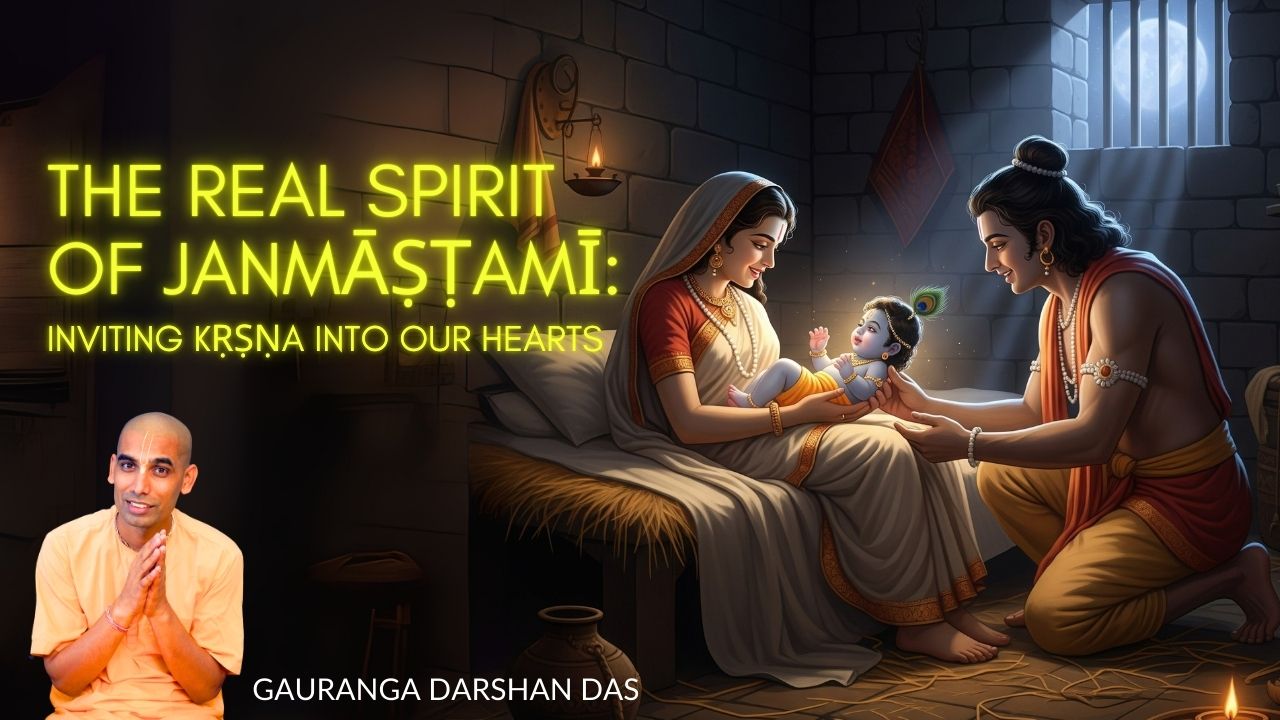
The Real Spirit of Janmāṣṭamī: Inviting Kṛṣṇa into Our Hearts
Janmāṣṭamī is the sacred celebration of Lord Kṛṣṇa’s divine appearance in this world. On this auspicious day, devotees commemorate the moment Kṛṣṇa manifested as the son of Vasudeva and Devakī. However, Kṛṣṇa’s "birth" is unlike ours. He is aja—the unborn, without beginning or end. Just as the sunrise does not mark the birth of the sun, Kṛṣṇa’s appearance is not His origin, but the commencement of His pastimes in a particular universe. And just as sunset does not signify the sun’s death—merely its setting in one place and rising in another—Kṛṣṇa concludes His pastimes in one universe only to begin them elsewhere. When the next day of Brahmā arrives, Kṛṣṇa reappears, just as the sun rises again where it had once set. Thus, Kṛṣṇa proclaims in the Bhagavad-gītā (4.9): janma karma ca me divyam—His appearance and activities are transcendental. Though ever present, He becomes visible when the time is ripe, to bless and uplift the world. Devotees around the globe celebrate Janmāṣṭamī with joy, reverence, and heartfelt devotion. Yet beyond the external celebrations, this sacred day poses a deeply personal question: Has Kṛṣṇa appeared in our hearts? To welcome Him, we must do what the great souls of the Bhāgavatam did—prepare our hearts with sincerity, humility, and longing. For it is not just a historical event we observe, but a divine opportunity to invite Kṛṣṇa into our lives—where He can appear, stay, and never depart. 1. Preparing Our Hearts for KṛṣṇaThe story of Lord Kṛṣṇa’s parents—Devakī and Vasudeva—offers a powerful lesson in devotion and surrender. On the very day of their marriage, a divine prophecy declared that Devakī’s eighth child would be the cause of her brother Kaṁsa’s death. Enraged and fearful, the tyrant Kaṁsa imprisoned the couple and mercilessly killed their first six children. The seventh child, Lord Balarāma, was mystically transferred to the womb of Rohiṇī, paving the way for Kṛṣṇa’s divine appearance. According to our Vaiṣṇava ācāryas, these six slain sons symbolize the six anarthas—lust, anger, greed, pride, envy, and illusion. Lord Balarāma represents guru-tattva, the principle of the spiritual master. What does this teach us? When the heart is cleansed of anarthas and guided by a bona fide spiritual teacher, it becomes a suitable place for Kṛṣṇa to appear. Removing inner impurities and accepting spiritual guidance prepares the ground for divine connection. This Janmāṣṭamī, let us reflect: Are we creating space for Kṛṣṇa in our lives? Are we ready for the inner purification required to welcome Him? 2. Enduring the Inevitable Discomfort Devakī and Vasudeva endured immense hardship—imprisonment, heartbreak, and constant fear. Yet they remained unwavering in their desire to receive Kṛṣṇa. Their sacrifice and steadfastness ultimately brought the Supreme Lord into their lives. Similarly, if we wish for Kṛṣṇa to appear in our hearts, we too must cultivate sincerity, perseverance, and a willingness to undergo inconvenience for His pleasure. Bhakti is not always comfortable—it calls for endurance and sacrifice. But the struggles we face in devotional service purify our hearts and attract the mercy of Kṛṣṇa.This Janmāṣṭamī, let us reflect: Are we willing to embrace inconvenience for His pleasure? Are we ready to choose devotion over comfort, and sacrifice over ease—for the joy of having Kṛṣṇa dwell within us? 3. Cultivating a Deep LongingWhen Lord Kṛṣṇa appeared in the dark prison cell of Kaṁsa, He filled it with divine radiance. More than just lighting up the space, He brought true joy to the hearts of Devakī and Vasudeva, who had endured unbearable sorrow. Likewise, when we patiently endure the struggles life brings, the moment Kṛṣṇa appears in our hearts becomes profoundly transformative. We realize that every hardship was worthwhile for that one moment of divine grace. But such moments don’t arrive accidentally. We must deeply desire them, sincerely endeavor for them, earnestly pray for them, and yearn with all our heart. Often, Kṛṣṇa first comes as subtle inspiration—nudging us toward deep devotion. As we serve with sincerity, that inspiration becomes longing, and longing ripens into a heartfelt cry. When that cry becomes pure and intense, Kṛṣṇa’s presence fills our hearts, dispelling the darkness of doubt, ego, and illusion with the light of divine knowledge, love, and bliss. Until then, we walk the sacred path of bhakti-yoga—with humility and steady dedication—knowing each step draws us closer to Him. This Janmāṣṭamī, let us reflect: Are we cultivating that longing for Kṛṣṇa’s presence? Are we allowing inspiration to grow into yearning, and yearning into transformation? 4. Sincerity over Grandeur or Simplicity Today, Janmāṣṭamī is celebrated with grandeur—temples adorned with flowers, elaborate abhishekams, sumptuous feasts, and vibrant cultural programs. But how did Devakī and Vasudeva celebrate the original Janmāṣṭamī? They had no palace, no garlands, no feast. Shackled in a dark prison, they celebrated not with outward opulence but with inner devotion. Vasudeva, though bound in chains, mentally gave thousands of cows in charity. Their hearts, not their surroundings, defined the celebration. And when Kṛṣṇa appeared, even the prison glowed with divine effulgence.True celebration – whether grand or simple – requires internal sincerity. The rituals—abhiṣekams, prasādam distribution, and decorations are to be offered with the right mood of pleasing the Lord (saṁsiddhir hari-toṣaṇam, SB 1.2.13). If our hearts are filled with love, humility, and devotion, even a simple Janmāṣṭamī becomes glorious. Without those inner qualities, even the grandest events may leave us feeling empty—and untouched by grace. This Janmāṣṭamī, let us reflect: Are we focused more on the celebration or on whom we are celebrating? Are our offerings filled with devotion, or merely decoration? Śrīla Prabhupāda Invites Kṛṣṇa on the JaladutaHow did Śrīla Prabhupāda, the beloved Founder-Ācārya of ISKCON, celebrate Janmāṣṭamī while sailing across the Atlantic on the Jaladuta? For over forty years, Śrīla Prabhupāda tirelessly endeavored to spread Kṛṣṇa consciousness across the globe. Despite facing repeated setbacks, he never gave up. He showed the world that real success lies not merely in achieving results, but in remaining steadfast through failure. True failure is giving up; true success is serving on with unwavering faith. Eventually, by Kṛṣṇa’s mercy, Śrīla Prabhupāda received passage aboard the Jaladuta, alone, heading toward the unknown shores of the USA. During this solitary voyage, Janmāṣṭamī arrived. There were no temples, no devotees, no elaborate arrangements. Yet, Prabhupāda celebrated simply—offering little bhoga, singing a small kīrtana, and speaking Kṛṣṇa-kathā to a few fellow passengers. That humble celebration, over fifty years ago, sowed the seeds for something extraordinary. Today, Janmāṣṭamī is celebrated by millions—not only in India, but across continents: in the USA, Australia, the UK, New Zealand, and beyond. Just as Vasudeva and Devakī celebrated Janmastami in the confines of a prison cell, Śrīla Prabhupāda celebrated on the rocking waves of the Atlantic. Both lacked external opulence, but were rich in faith and devotion. Today’s grand celebrations are possible only because of such pure-hearted sacrifices.The true spirit of Janmāṣṭamī, therefore, is gratitude—to Vasudeva and Devakī, to Śrīla Prabhupāda, and to all the ācāryas who brought Kṛṣṇa into our lives. The Real Spirit of JanmāṣṭamīJanmāṣṭamī is more than a date—it is an invitation. Kṛṣṇa doesn’t seek grandeur; He seeks sincerity. What pleases Him most is our genuine desire to serve, love, and remember Him.Let us not be spectators, but participants—cleansing our hearts and preparing a place for Him through service, japa, kīrtana, and kindness. As we decorate altars and offer bhoga, let us also present the garlands of our efforts, the lamps of our devotion, and the sweets of our purified intentions. Then, Kṛṣṇa will appear—not just in temples or scriptures, but within our hearts. This Janmāṣṭamī, let our grand celebration be marked by introspection, purification, and deepening devotion—a heartfelt invitation for Kṛṣṇa to reside in the temple of our hearts. Kṛṣṇa once lit up Kaṁsa’s dark prison. He can surely illuminate our hearts—if we let Him in, this Janmāṣṭamī.
Aug 15, 2025 157
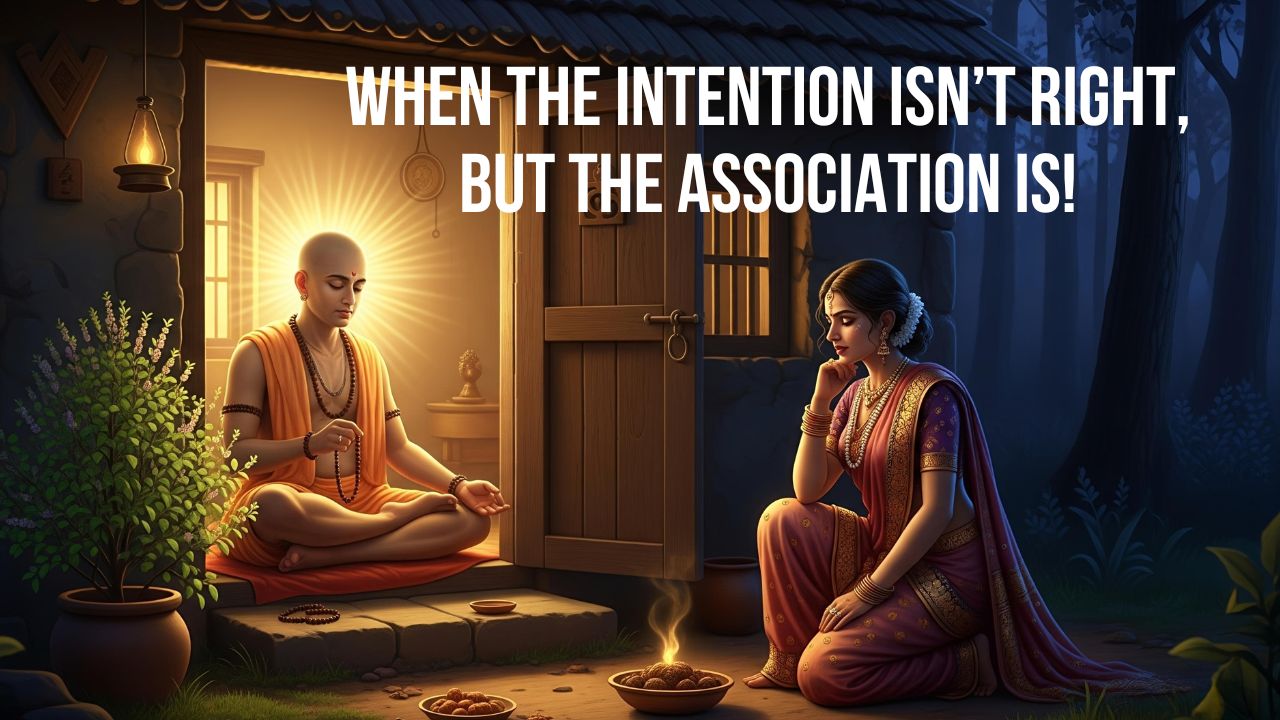
When the Intention Isn’t Right, But the Association Is!
Exploring the power of Sādhu-saṅga The company we keep can shape the course of our lives—this is especially true on the path of devotion. Sādhu-saṅga—the association of sincere devotees—is a priceless gift, a divine catalyst that awakens love for Lord Kṛṣṇa and invites His mercy to flow into our hearts. As repeatedly declared in the scriptures and experienced by innumerable devotees in the history, sādhu-saṅga is the lifeline of spiritual life. But here’s a question worth pondering: what happens when such saintly association is approached without sincerity or reverence—when it's tainted by material motives, inner resistance, or even envy? Can the presence of a devotee still touch the heart of someone who isn’t quite ready? Can even a reluctant or unintended encounter with a saintly soul open the door to transformation? Or might it cause more harm than good? Our sacred scriptures address these complexities with grace and depth. Ambitious princes, cruel hunters, venomous snakes, and even degraded prostitutes were transformed by the power of sādhu-saṅga—directly or indirectly—even when they neither desired nor deserved such mercy. Let us explore these stories not merely to admire the transformation of others, but to reflect on how we, too, can humbly approach this sacred gift of sādhu-saṅga. 1. An Innocent Woman Attains Spiritual Perfection The Śrīmad Bhāgavatam reveals a deeply moving truth: even when one approaches a saintly soul with material desires, their purity can still uplift and transform the seeker. This is powerfully illustrated in the words of Devahūti, spoken to her husband Kardama Muni: saṅgo yaḥ saṁsṛter hetur asatsu vihito ’dhiyāsa eva sādhuṣu kṛto niḥsaṅgatvāya kalpate ‘Association aimed at sense gratification is certainly the cause of bondage. But the same association, when directed toward saintly persons, leads to liberation—even if done unknowingly.’ (SB 3.23.55) Kardama Muni, the son of Lord Brahmā, performed intense devotional austerities and meditated on Lord Viṣṇu for 10,000 years, and ultimately attained the Lord’s darśana and blessings. He later married Devahūti, the noble daughter of Svāyambhuva Manu. Before their marriage, Kardama clearly stated that he would remain with her only until she bore children, after which he would renounce worldly life—a condition Devahūti and her family humbly accepted. After marriage, Devahūti served Kardama Muni with unwavering dedication, neglecting her own physical comfort. Touched by her sincerity, Kardama told her, “Because of your pure-hearted service, you shall receive the results of my spiritual practices. I bless you with freedom from fear and sorrow, and divine love for the Lord.” Without undergoing penance like her husband, Devahūti received immense spiritual blessings—simply through sincere service. Such is the grace of true saints: like a lamp lighting many others without diminishing itself, their blessings elevate others far beyond what could be earned through personal effort. Yet in her innocence, Devahūti wasn’t ready to receive spiritual perfection. Instead, she gently expressed an apparently worldly desire: “I wish for a child.” But this too was part of the divine plan—for through her, the Supreme Lord would descend as Lord Kapila. By Kardama’s mystic power, Devahūti gave birth to nine beautiful daughters. As promised, Kardama prepared to leave home. Moved by emotion, Devahūti softly lamented, “You offered me eternal love for the Lord, but I asked for fleeting joys. Still, let the affection I have for you free me from fear. The association of a saint, even in ignorance, must lead to liberation.” (SB 3.23.54–55) Hearing Devahūti’s heartfelt words, Kardama stayed a little longer. In due course, Lord Kapila, an incarnation of Lord Viṣṇu, was born. After entrusting Devahūti to the care of their divine son, Kardama renounced family life and departed for the spiritual world. Later, Devahūti received profound spiritual instructions from Lord Kapila and attained spiritual perfection. Mother Devahūti’s statement in the quoted verse is vividly affirmed in several inspiring examples, as illustrated below. 2. An Ambitious Prince Attains the Lord’s Darshan  Dhruva, a five-year-old prince, was deeply hurt when his stepmother insulted him and forbade him from sitting on his father's lap. Burning with anger and a desire for revenge, he resolved to attain a position greater than even that of Lord Brahmā. With this ambition, he left for the forest to worship Lord Vāsudeva. There, he encountered Nārada Muni, who advised him to let go of his anger and return home. But Dhruva, determined to fulfill his material desires, insisted that Nārada show him a way forward. Far from being offended by Dhruva’s refusal, Nārada appreciated the boy’s unwavering resolve and chose to redirect it towards devotion (bhakti). With compassion, he gave Dhruva the mantra—“oṁ namo bhagavate vāsudevāya”—and instructed him to chant it in the sacred land of Vṛndāvana. Following these instructions with sincerity, Dhruva worshipped the Lord with intense devotion and, within just six months, attained the darśana of Lord Viṣṇu. The Lord, pleased with Dhruva’s devotion, not only granted him a spiritual planet to reside in but also fulfilled his material desires. However, by this time, Dhruva’s heart was transformed by his sincere following of Narada Muni’s instructions. All his earlier anger and material ambitions melted away. Regretful of his past desires, he gave up all resentment toward his stepmother. Such is the power of sādhu-saṅga—a saintly person like Nārada can redirect even material motivations into the path of pure devotion, ultimately leading to spiritual perfection. Just as fire burns whether one touches it knowingly or not, the company of a saint purifies—whether we are aware or unaware, ready or not. 3. A Prostitute Becomes a Pure Vaiṣṇavī Here is yet another and even more powerful example of the transformative power of sādhu-saṅga. In the village of Benāpola, Nāmācārya Haridāsa Ṭhākura was revered for his saintly character, boundless humility, and unwavering commitment to chanting the Hare Kṛṣṇa mahāmantra. But not everyone appreciated his fame. Driven by envy, a man named Rāmacandra Khān devised a cruel scheme to tarnish Haridāsa’s reputation. He sent a prostitute to seduce and discredit him publicly. One night, the woman entered Haridāsa’s hut, pretending to seek pleasure. Haridāsa, undisturbed, replied, “I have a vow to complete a certain number of rounds of chanting. Once I finish, I’ll speak with you.” She waited all night but Haridāsa never stopped chanting. She returned the next night—and again heard the same reply. And again, on the third night. But something unexpected was unfolding. Without any philosophical lecture, moral reprimand, or scriptural discussion—simply by being in the presence of a pure devotee and hearing the holy name—her heart began to change. What began with deceit turned into a deep spiritual awakening. The sound of harināma, the atmosphere of purity, and Haridāsa’s serene devotion melted her hardened heart. At last, she fell at his feet and confessed everything. Haridāsa gently said, “I knew who sent you. I had thought of leaving this place, but I stayed—just for you.” No anger, no pride, no condemnation—only compassion. This is the heart of a true Vaiṣṇava—seeing no enemies, only souls waiting to be uplifted. Even someone caught in sin is not beyond redemption when touched by such mercy. Haridāsa mercifully instructed her to renounce her sinful profession, surrender to Kṛṣṇa, serve Tulasī Mahārāṇī and chant the holy names. He took no credit, saying simply, “I have lived in this hut. Now, you may stay here,” and quietly departed. She shaved her head, donned simple clothes, and began sincerely chanting the Hare Kṛṣṇa mahāmantra. Her transformation was so profound that even other devotees began to seek her blessings. This is the power of sādhu-saṅga. A pure heart filled with devotion can awaken dormant spirituality in others. We may carry doubts, regrets, and shortcomings, and feel unworthy at times. But this sacred pastime reminds us: no one is too fallen. No one is beyond redemption when touched by the mercy of a true devotee. 4. A Python Purified and Liberated Another striking example of the Lord’s mercy upon those connected to His devotees is seen in the story of Aghāsura. Aghāsura, a gigantic python demon, came to Vṛndāvana with a deadly plan—not just to kill Kṛṣṇa, but also all His cowherd friends and calves. Taking the form of an enormous serpent, eight miles long, Aghāsura lay down on the forest path with his mouth gaping wide like a cave. The innocent gopas mistook the python’s body for a beautiful cave and, attracted by the sight, playfully entered along with their calves. Kṛṣṇa wanted to stop them, but they had already gone inside. Aghāsura, waiting for Kṛṣṇa, did not immediately close his mouth—he wanted to swallow them all together. Invincible Kṛṣṇa then entered the demon’s mouth. Expanding Himself within Aghāsura’s throat, Kṛṣṇa blocked the demon’s breathing. Suffocated and overwhelmed, his breath stopped, his eyes bulged, and his soul burst out from the top of his head, hovering in the sky before merging into Kṛṣṇa’s divine body. Meanwhile, Kṛṣṇa glanced at His unconscious friends and calves—who had collapsed from the poisonous fumes—and revived them with His merciful glance. Although Aghāsura had come with murderous intent, Kṛṣṇa granted him liberation. Because even unintentionally, Aghāsura gave pleasure to the Lord’s devotees—his tongue became a playful path, and his body, after death, a playground for the Vrajavāsīs. Even an enemy of the Lord, if somehow connected to the Lord’s pleasure or His devotees, can be purified and delivered. Such is the limitless mercy of Kṛṣṇa. 5. A Venomous Snake Becomes a Humble Servant In the forest of Vrindavan, young Kṛṣṇa leapt into the poisoned waters of the Yamuna to confront Kāliya, a venomous serpent who had made the river his home. Kṛṣṇa didn’t aim to destroy Kāliya, but to purify him—both externally and internally. For a full muhūrta (48 minutes), Kāliya arrested Kṛṣṇa in his coils, in other words the serpent embraced the Lord tightly, an experience of intimacy few could only imagine. Later, Kṛṣṇa released Himself from the serpent’s coils and subdued him, and started danced upon his innumerable hoods, allowing Kāliya to receive the dust of His lotus feet. What a great fortune? - Embracing the Lord for 48 minutes and receiving the dust of His lotus feet upon his heads! One might assume such direct contact with the Lord would be enough for Kaliya to attain complete perfection. Yet, Kāliya's true deliverance came only through the heartfelt prayers of his noble wives, the Nāgapatnīs. It was their humility, devotion, and sincere appeal that touched Kṛṣṇa’s heart and secured Kāliya’s forgiveness and release. This episode reveals a profound truth: even being physically close to Kṛṣṇa does not guarantee His full mercy if the heart lacks the right disposition. Kāliya’s transformation was completed only when the Lord’s devotees intervened on his behalf and offered well-wishing prayers. Kṛṣṇa’s mercy flows most freely through His devotees. To approach Him directly without valuing or honoring His devotees doesn’t please the Lord. Without sādhu-saṅga (the association of saints) and sādhu-kṛpā (their blessings), our relationship with Kṛṣṇa remains fragile and partial. 6. Power of Connection with a Devotee Sārvabhauma Bhaṭṭācārya was a renowned devotee of Lord Caitanya Mahāprabhu in Jagannātha Purī. On one occasion, his son-in-law, Amogha, harshly criticized and offended Lord Caitanya. As a consequence of his offense, Amogha was afflicted with cholera. Hearing of this, Lord Caitanya immediately went to Amogha’s home and, by His merciful touch, not only cured him of the disease but also purified his heart of the offensive mentality. The Lord explained that it was only because of Amogha’s connection with His dear devotee, Sārvabhauma, that He was showing such mercy and forgiving all his offenses. Lord Caitanya declared: "sārvabhauma-gṛhe dāsa-dāsī ye kukkuraseha mora priya, anya jana rahu dūra" "Everyone in Sārvabhauma Bhaṭṭācārya’s house is very dear to Me—including his maids, servants, and even his dog. And what to speak of his relatives?" This reveals the extraordinary value the Lord places on those who are even indirectly connected to His devotees. But what does this really mean? Can we simply associate with a devotee and continue holding on to material desires, poor character, or whimsical behavior—thinking that connection with a devotee alone is enough? Let’s explore this further. Grace Beyond Worthiness The Seventh Canto of the Śrīmad Bhāgavatam reveals a profound truth: if someone intensely meditates on the Lord—even with negative emotions like envy, fear, or hatred—the Lord still grants them liberation, if their negative emotion leads to intense absorption in remembering the Lord. Such is the extent of His mercy. Śiśupāla constantly thought of Kṛṣṇa with hatred. Hiraṇyakaśipu and Hiraṇyākṣa despised Him. Kaṁsa lived in fear of Him. Yet all were liberated, not because of their intentions, but because their minds were deeply and continuously absorbed in the Lord. Absorption in the Lord—even if triggered by negativity—can attract His mercy. Similarly, prolonged association with a devotee, even if initially fueled by malice or envy, can eventually purify the heart and lead to divine grace. However, this is not a path to imitate. One cannot intentionally offend or hate a devotee hoping to be delivered. These are rare exceptions. If one's negativity lacks the deep absorption of Śiśupāla or Kaṁsa, the result is not liberation—but suffering. Far better is the path of humble service and sincere association. Let us not approach sādhu-saṅga carelessly, but with reverence, gratitude, and an open heart. So, lets hold tightly to the feet of devotees—with all our hearts. Whether they walk among us today or speak through the timeless words of scripture, lets seek their shelter, hear their prayers and learn from their lives. Let their devotion awaken ours. Because in the journey of life, it is not brilliance, strength, or status that leads us home—it is sincerity. Even if our intentions are not fully pure, if we humbly serve and stay close to the devotees, our hearts will change. Gradually, our lower desires will give way to divine longing. And one day—almost without realizing it—we too will stand at the doorstep of spiritual perfection, with love for Kṛṣṇa blooming in our hearts. That is our hope. That is our home. But the discussion doesn’t end here! We Were Uplifted—Now It's Our Turn So far, we have discussed the incredible potency of sādhu-saṅga—the association of saintly devotees—in spiritually uplifting even those who approach with impure intentions. This is a profound lesson for everyone practicing Kṛṣṇa consciousness. As sādhakas, or practitioners on the path of bhakti, we must strive to cultivate saintly character and deep devotion to the Lord—in other words, we must endeavor to become sādhus. When common people come to us seeking sādhu-saṅga, it is our responsibility to offer them uplifting association that inspires them spiritually and positively transforms their lives. Our presence should benefit them—even if they come with poor character or wrong intentions. Of course, it can be challenging to deal with those who approach us with negative mindsets. Still, a sincere spiritual practitioner must learn to be kind, tolerant, and compassionate—while safeguarding ourselves from them. A sādhu maintains integrity by not harboring grudges, envy, or malice, even toward those who act wrongly. Instead, they act as true well-wishers, desiring the spiritual welfare of all, sincerely trying to help others on their spiritual path, and praying to Kṛṣṇa for their upliftment. It is this desire, this endeavor, and this prayer of a sādhu that can help those suffering in material existence come closer to the spiritual path. The true ornaments of a sādhu are their saintly qualities. Only when we develop sādhu-lakṣaṇas—such as compassion, gratitude, humility, tolerance, non-enviousness, contentment, and respect—can we offer genuine sādhu-saṅga. Only then can our association deeply touch hearts and spiritually transform lives. If we ourselves lack sādhutva or saintliness, how can we expect our presence to uplift others? One cannot offer what one does not possess. In this sacred service of guiding others to Kṛṣṇa, we must also remain humble. Humility is an integral part of saintly character. We should never think of ourselves as the doers or originators of compassion. We are simply instruments—channels for the compassion of Kṛṣṇa and the great ācāryas. As representatives and servants of Guru and Kṛṣṇa, we are meant to offer spiritual association in a way that heals and uplifts—not in a way that adds to the frustration already inflicted by material energy. The tolerant, forgiving, accommodating, and well-wishing nature of a sādhu is the only hope for the conditioned souls. We ourselves were once uplifted by sādhu-saṅga—and that is why we are now on the spiritual path. If we fail to extend the same compassionate association to newcomers—despite their countless faults—how can we expect the society of devotees to grow and thrive? A vibrant and flourishing devotional society can only be built on the foundation of personal integrity and saintly character.
Jul 20, 2025 130
Lord Rama’s Shelter: A Refuge for All, Even the Rejected
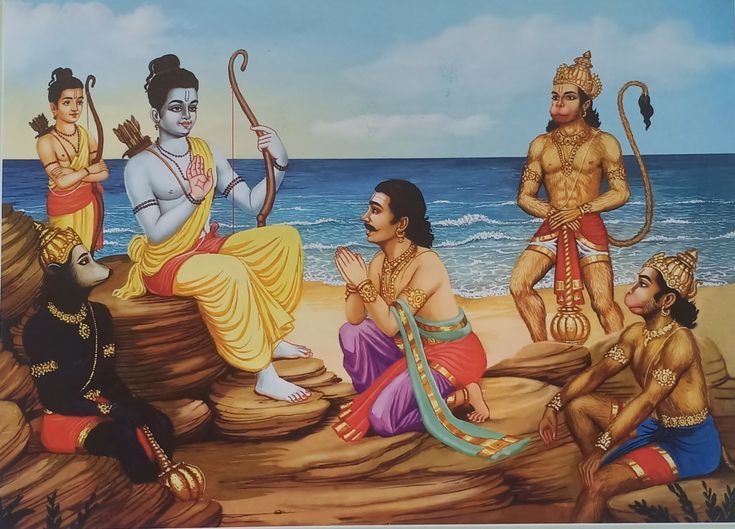
Vibhishana had wisely decided that Lord Rama’s cause was superior to Ravana’s. He abandoned his brother, crossed the ocean, and sought the shelter of Rama. Rama asked the opinion of the monkey chiefs. Sugriva was highly suspicious; after all, Vibhishana was a rakshasa and the brother of Ravana. Other monkey chiefs had reservations about placing any trust in Vibhishana. But Hanuman had not detected any deceit or ill motives in the speech or expression of Vibhishana. He believed that Vibhishana was moral and desired to assist Rama. Rama thanked the monkeys for their opinions and then gave His opinion, “This is My solemn vow. If anyone comes to Me saying, ‘O Lord, I am yours’ even once, then I shall give him all protection from all danger forever. Even if Ravana came to Me, I would not refuse him shelter.” The Lord’s speech deeply moved the hearts of all. Rama gracefully accepted Vibhishana, and Vibhishana gratefully joined Rama’s company. The Lord doesn’t refuse to accept a supplicant who sincerely seeks His shelter. While egoistic demons abandon their own people as enemies, God and godly people accept even ‘enemies’ as their own friends. Rama was willing to forgive all offenses of Ravana and give him mercy. Although Rama disapproved of Ravana’s deeds, He didn’t disown him at heart. But unfortunately, Ravana wasn’t willing to seek Rama’s shelter, overwhelmed by lust. The conditioned soul’s case is somewhat similar. The Supreme Lord is ready to forgive and forget the misdeeds of the living entities if they surrender unto Him. But their insatiable lust and independent material desires keep them away from seeking the Lord’s shelter. Although God is ready to forgive, the conditioned soul is often not ready to beg forgiveness due to lust and false ego. To reach Lanka, Rama’s army had to cross the ocean. Rama fasted for three days in meditation, seeking the help of the ocean-god. But the ocean-god did not respond. Rama became angry, and simply by His glance, the aquatics within the ocean were perturbed. The ocean-god then hastily came and fell at the feet of Rama and suggested Him to make a bridge with stones. Merciful Rama forgave the ocean-god and commenced the construction of the historical bridge. Thousands of monkeys brought stones, big and small, and in a short time, a magnificent bridge was made, and the army reached Lanka, causing astonishment and fear to the rakshasas. The monkeys surrounded the golden city awaiting encounter. But Rama wanted to give another chance to Ravana. He sent Angada, Sugriva’s nephew, to Ravana with a message to respectfully return Sitadevi. But proud Ravana ordered his servants to kill Angada. Angada, however, leaped onto the top of Ravana’s palace and kicked the roof, causing the dome to crumble. Amazed at Angada’s prowess, Ravana looked on as Angada soared away. Thus, this final attempt to stop the war also failed. While virtuous people prefer peaceful coexistence, vile people prefer war only to exist alone. Just as Lord Rama’s message to stop the Lanka war wasn’t agreeable to lusty Ravana, who was attached to a woman, Lord Krishna’s message to stop the Kurukshetra war wasn’t agreeable to greedy Duryodhana, who was attached to the kingdom. Both were too proud and egoistic to submit. Pride, attachment, lust, and greed overpower people so much that they pay no heed to even God’s words. THE FINAL CONFRONTATION The war was inevitable. The parties of Rama and Ravana confronted each other on the battlefield. Great heroes from both sides fought to the death day after day, with thousands of fatalities among the troops. One by one, Ravana’s warriors and sons were dying, yet his infatuation and ego didn’t diminish. The battle continued, and eventually, Ravana was killed by Rama’s arrows in a fierce battle. His physical strength, skill in war, mystic powers, millions of followers, knowledge, and even the boons that he received from great devatas didn’t save him from his inevitable death. All this was due to his lust for a chaste woman, whose purity and tears ruined his race and very life. When leaders are not self-controlled, the followers cannot prosper any more than sheep protected by a jackal. ‘HATE THE SIN, NOT THE SINNER’ Maricha’s good advice, Sita’s rebuking warnings, Jatayu’s opposition, Hanuman’s caution note, Kumbhakarna’s admonishment, Vibhishana’s well-intended counseling, Angada’s peace message, and so on – none of them could transform the lusty determination of stubborn Ravana. Thus, he brought about his own destruction. Just as an efficient receiver catches signals from a good transmitter, an intelligent person grasps good counsel from a well-wishing source. But proud people can’t do so. Unfortunate are those who do not have access to worthy advice. More unfortunate are those who care nothing for good advice even when available. A chaste woman can understand the power of another chaste woman. Mandodari, the chaste queen of Ravana, lamented at his death, “O Lord! Although you conquered your senses to win great boons by austerities, in the end, you have been conquered by those very senses. Fallen prey to lust, you desired to enjoy the sinless Sita, although I was always your devoted consort. By tormenting that godly lady, the emblem of chastity and nobility, you brought destruction upon yourself and all your dynasty.” Other ladies took her aside as she wailed. Unfulfilled material lust captivates even powerful kings and learned scholars in its shackles and ultimately leads to their ruination. Vibhishana also mourned for the death of his brother, who never listened to his good counsel. The very fate that he predicted for Ravana had come to pass. Although shunned by Ravana, Vibhishana always desired his welfare. Rama consoled Vibhishana, “Ravana has died a heroic death, the end sought by all warriors. Death has ended all animosity. Ravana is now the same to Me as you. Please perform his funeral.” Vibhishana reflected a few moments. Although he loved his brother, he strongly disapproved of his heinous sins. He told Rama that he was unwilling to do the funeral rites for a cruel and merciless person. A funeral would be an act of honor that Ravana didn’t deserve, and Vibhishana couldn’t perform it honestly. Lord Rama smiled and said, “O Vibhishana, the soul can never be hated. Ravana’s sinful body is now dead, but his pure soul continues to live. And the soul is always worthy of respect. You should therefore carry out the rites for the eternal good of your brother’s immortal soul.” The pure spirit soul is a fragmental part of the Supreme Lord who is eternally pure. With the material body comes the sinful contamination, due to which the spiritual glory of the soul is not fully revealed. However, the temporary sinful disposition of the pure soul doesn’t permanently deprive the soul of an opportunity to be situated in his eternal glory of being a loving servant of the Lord. Though God punishes someone externally, He has only love and affection for all souls on a spiritual level. Ultimately, all material experiences are only a temporary phase in the eternal life of the immortal soul. Ravana’s sins had ended with his body, especially as it had been slain by Lord Ramachandra Himself. Vibhishana, by Rama’s inspiration, began the necessary rituals for Ravana’s funeral. This is an excerpt from the book Disapproved but not Disowned by Gauranga Darshan Das.
Apr 2, 2025 326
Complaints of Love
Complaints of Love
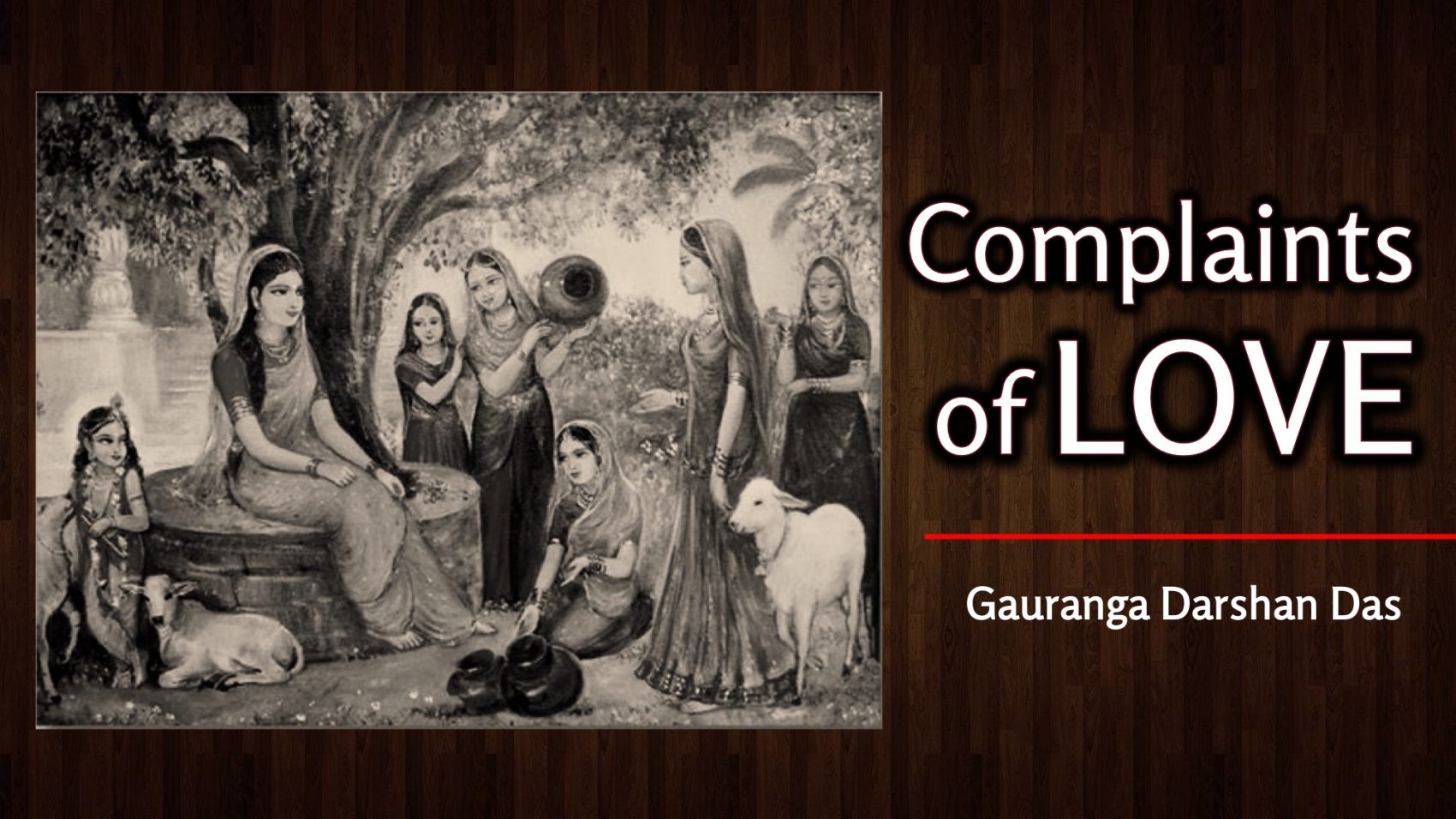
Krishna’s pastimes are most enchanting, but when His devotees narrate them, they taste even more nectarean, being mixed with their love. Isn’t it ironic to see a rich man steal like a petty thief? Isn’t it even more astonishing to see him steal food, as if he were a hungry, poverty-stricken man?! What if God acts like this? Lord Krishna is the supreme proprietor of all the material and spiritual worlds and is the husband of the goddess of fortune. He is the son of the king of Vrndavana, Nanda Maharaja, and is lovingly raised by queen Yasoda. Yet He is accustomed to stealing in the houses of vraja-gopis, the ladies of Vrndavana. And what does He steal? Not gold or wealth, but some milk, curd, and butter! Krishna’s naughty pranks know no bounds. Although the gopis relish them, they rebuked Him externally. They went to mother Yasoda and lodged complaints against Krishna. And at times Yasoda defended her darling Krishna, who acts innocently. The following is just a sample verse from the Bhagavatam (10.8.29) that the gopis spoke to Yasoda, describing the stealing activities of naughty Krishna. vatsan muncan kvacid asamaye krosa-sanjata-hasah steyam svadv atty atha dadhi-payah kalpitaih steya-yogaih markan bhoksyan vibhajati sa cen natti bhandam bhinnatti dravyalabhe sagrha-kupito yaty upakrosya tokan Releases calves at odd times (vatsan muncan kvacid asamaye) The gopis said in agitation, “Krishna comes to our houses and releases the calves (vatsan muncan).” Yasoda said, “What is Krishna’s fault in this? He cares for the calves.” The gopis, “But He does it when it is not milking time (kvacid asamaye). The calves naturally drink all the milk, and when we go for milking the cows, we don’t get any milk!” Yasoda, “Krishna is just a child. He has done this out of ignorance. There are many people in the house. Can they not prevent it?” The gopis, “No, this boy comes when they are busy in various household engagements, and then releases our calves.” Yasoda, “Why don’t you frighten Him?” Mellows down anger with a smile (krosa-sanjata-hasah) The gopis, “When we become angry (krosa-sanjata) at Him and shout, ‘Beat Him, tie Him up…’ He merely smiles (hasah). Smitten by His intoxicating smile, we just helplessly watch Him do His dirty work.” Yasoda asked, “But, why does He release the calves at all?” Eats milk products by stealing (steyam svadv atty atha dadhi-payah) Laughing, the gopis imitate Krishna’s answer, “‘I want to drink milk!’” They described, “Krishna releases the calves to make people run here and there. And then He enters our houses, steals whatever He likes and eats (steyam atty atha) our tasty (svadv) milk and curd (dadhi-payah). Yet, we are unable to do anything, while He drinks the milk and curd even as He relishes the spoils of His thievery right in front of our eyes! He just sits there and eating, not even posturing to running away, while we stand there watching His antics bewildered by His smile.” Yasoda said, “Oh you are so unkind! Why didn’t you just give Him some milk before He takes it by Himself? The boy must be hungry. Why don’t you just let Him eat till His belly’s full?” With smiling brows, the gopis said, “His belly is always full, since He is always being fed by you. It is not a question of hunger. He has a taste for stealing! He wants stolen milk only, not the milk which we give Him. If we give Him milk, He will not drink it.” Yasoda said, “Fine! But what is the loss if He takes little milk from your storehouse?” The gopis replied, “He takes the tastiest milk (svadv) that we set aside for our husbands.” Yasoda defended Krishna, “It is not possible for an untaught, innocent child to steal from you, for you are very clever.” Invents ways of stealing (kalpitaih steya-yogaih) The gopis described Krishna’s expertise in stealing, “Innocent! Your son is uncannily intelligent. He has invented (kalpitaih) innovative methods of stealing (steya-yogaih) unseen or unheard of. He is so skillful that He releases our calves even whilst we are directly watching, mystifying us with His smile.” Yasoda said, “This is the result of piety of your ancestors that Krishna is enjoying at your homes what is not given by you misers. Why don’t you accept this joyfully?” Distributes butter to monkeys (markan bhoksyan vibhajati) The gopis said, “We are happy if He eats our butter, even with His friends. But before He eats it, He divides it (vibhajati) and gives it to the monkeys to eat (markan bhoksyan). But the monkeys had overeaten already and their bellies were already full.” Breaks pots (sa cen natti bhandam bhinnatti) The gopis continued, “So they don’t eat. Even if one monkey does not eat the butter (sa cen na atti), Krishna also does not eat it! He would say, ‘Without you, what is the use of My eating? I will not eat.’” Then, in distress, He simply breaks the pots (bhandam bhinnatti). And sometimes, since He has eaten already, He does not eat the stolen food but still breaks the pots and blames others.” Yasoda said, “If you know all this, why don’t you hide the pots? By not doing so, you are making my playful child agitated.” Becomes angry (dravyalabhe sagrha-kupito) The gopis replied, “We tried hiding our pots. But if Krishna can’t find the eatables (dravya alabhe), He (sa) becomes angry at the residents of the house (grha-kupito). He becomes furious when the gopis do not follow His order to give butter to the monkeys that have come to the door. He would say, ‘Stay there, and I will come tomorrow morning with a flaming coal in my hand. If you don’t give Me yogurt, I will burn your house down along with the elders and children.’” Pinches babies (yaty upakrosya tokan) The gopis continued, “Then He would pinch and irritate the babies (upakrosya tokan) or scratch them with His nails, and run away (yaty).” In this way, there was no end to the complaints of the gopis about Krishna. Sometimes, as the gopis spoke, Krishna would be present there, but displayed very gentle behavior, as if He were so innocent and the gopis’ complaints were all lies. Sometimes mother Yasoda defended Krishna in front of the gopis, but sometimes she also chastised Krishna to discipline Him and teach Him good conduct. That was her absorption in her eternal mood as the mother of Krishna, the Supreme Godhead, acting as the Supreme Thief. By stealing butter, however, Krishna was actually stealing the butter-like hearts of the gopis. He was not hungry for milk, but was hungry for the milk of their motherly love. It was actually the greatest pleasure of the gopis to see Krishna stealing from their homes. In fact, they prepared all kinds of milk products in anticipation that Krishna would come and steal them. Although the gopis relished the stealing activities of Krishna, they rebuked Him externally. These simple gopis were very much appreciative of Yasoda’s fortune in being Krishna’s mother. But they thought she must be bereft of the pleasure of witnessing Krishna’s stealing pastimes, for He wouldn’t steal butter in her house. To give the same pleasure to Yasoda, the gopis went to her house to narrate Krishna’s pastimes of stealing in the garb of criticizing and complaining against Him. Krishna’s pastimes are most enchanting, but when His pure devotees like the gopis or Sukadeva Gosvami in the Bhagavatam narrate them, they taste even more nectarean, being mixed with the love of these devotees. Thus, Mother Yasoda experienced a greater pleasure upon hearing about Krishna’s stealing pastimes from the gopis than the gopis did by witnessing them firsthand. The gopis’ apparent angry complaints were nothing but expressions of their loving affection for Krishna, the Supreme butter thief (makhana-cora) who steals everyone’s pure heart. This article is based on the commentaries of Srila Prabhupada, Srila Visvanatha Cakravarti Thakura and Srila Jiva Gosvami on Srimad Bhagavatam 10.8.29.
Jan 11, 2025 83
Nine Glories of Sri Gauranga’s Lotus Feet
Lord Kṛṣṇa says in the Bhagavad-gīta that He descends in every yuga as an incarnation for three purposes: to protect the righteous, to punish the mischievous, and to establishes dharma. Lord Śrī Kṛṣṇa descended in the current age of Kali as Lord Śrī Kṛṣṇa Caitanya Mahāprabhu or Śrī Gaurānga. In this incarnation, the Lord appears in the form of a devotee to teach how to perform loving devotional service (bhakti) unto Him. Assuming the emotions of a devotee, Lord Gaurānga constantly chants Kṛṣṇa’s holy names and thus spreads the yuga-dharma or the process of salvation for this age, which is kṛṣṇa-nāma-saṅkīrtana or congregational chanting of the holy names of Kṛṣṇa. dhyeyaṁ sadā paribhava-ghnam abhīṣṭa-dohaṁtīrthāspadaṁ śiva-viriñci-nutaṁ śaraṇyambhṛtyārti-haṁ praṇata-pāla bhavābdhi-potaṁvande mahā-puruṣa te caraṇāravindam The above verse of Śrīmad Bhāgavatam (11.5.33) describes how the lotus feet (caraṇāravindam) of the great personality (mahā-puruṣa) Śrī Gaurānga Mahāprabhu are glorious in nine ways – dhyeyaṁ sadā – eternal object of meditation paribhava-ghnam – destroy the insults of material life abhīṣṭa-dohaṁ – award the greatest desire of the soul tīrthāspadaṁ – shelter of holy places and saintly people śiva-viriñci-nutaṁ – honoured by Śiva and Brahmā śaraṇyam – worthy of surrender bhṛtyārti-haṁ – relieve the distress of devotees praṇata-pāla – protect those who simply bow down bhavābdhi-potaṁ – boat to cross the material ocean 1. Eternal object of meditation (dhyeyaṁ sadā) Dhyeyam refers to “an object that is to be meditated upon.” Sadā means “always.” The worthiest object of everyone’s meditation is the Supreme Lord and His divine form, name, pastimes, and qualities. And that meditation is to be done constantly (sadā). There are no hard and fast rules about time and place for such devotional mediation. Meditation on the Lord begins from His lotus feet. It is repeatedly recommended by the scriptures that a devotee should always meditate upon the Lord’s lotus feet to purify one’s consciousness. Dhruva Mahārāja says that happiness can be attained only in two ways (SB 4.9.10), namely – meditation of the Lord’s lotus feet (tava pāda padma dhyānāt), and hearing about Him in the association of His devotees (bhavat-jana kathā śravaṇa). The moon-like effulgence emanating from the toenails of the Lord’s lotus feet destroys the thick gloom of darkness of ignorance in our hearts (SB 3.28.21). In Kali-yuga the authorized process of meditation is to chant the holy names of the Lord, especially the Hare Kṛṣṇa mantra which Lord Gaurānga had propagated far and wide in His pastimes. 2. Destroy the insults (paribhava-ghnam) Paribhava means “insults in material existence.” Ghnam refers to “destruction.” The very fact that the blissful spirit soul is entrapped in the material world undergoing unnecessary suffering itself is an insult (parābhava) for the soul! The merciful lotus feet of Lord Gaurānga destroys this humiliation.In this Kali-yuga, the age of quarrel, people cannot tolerate others’ prosperity and status, and thus there are fights even among family members, what to speak of states or nations. The real cause of all problems is the identification of the soul with the material body and mind. Such false identification makes one believe that a temporary sense of enjoyment gives happiness, although it ultimately gives pain, and pursuing it causes insult. And people are further tormented by excessive heat, cold, famine, drought, and so on in this world. All these harassments and embarrassments caused by envious people (ādhibhautika kleśas), by one’s own body and mind (ādhyātmika kleśas), or by natural calamities (ādhidaivika kleśas) can be relieved by taking shelter of the lotus feet of Lord Gaurānga Mahāprabhu. One who takes shelter of His lotus feet loosens the hard knot that psychologically binds one to bodily identification and resultant attachment. Then, one need not face any more insults in this world and be spiritually blissful. 3. Award the greatest desire (abhīṣṭa-dohaṁ) Abhīṣṭa means “desire.” Dohaṁ means “to give.” The living being in this material world may have unlimited material desires. But in the purest state of the soul, the soul only desires and hankers to love and serve Kṛṣṇa. Kṛṣṇa-prema or love of God is the deepest desire of every living being. Just as sugar is meant to be sweet, the soul is meant to love and serve Kṛṣṇa. Any other attitude or engagement of the soul is only a temporary and unnecessary cloud on the soul’s pure Kṛṣṇa consciousness. The mercy of Lord Caitanya’s lotus feet enables one to revive one’s dormant kṛṣṇa-prema. Lord Caitanya is so merciful that He gives the rarest kṛṣṇa-prema to the most fallen soul also without any reservations. Therefore He is called kṛṣṇa-prema pradāyate. cirād adattaṁ nija-gupta-vittaṁsva-prema-nāmāmṛtam aty-udāraḥā-pāmaraṁ yo vitatāra gauraḥkṛṣṇo janebhyas tam ahaṁ prapadye “The most munificent Supreme Personality of Godhead, known as Gaurakṛṣṇa, distributed to everyone—even the lowest of men—His confidential treasury in the form of the nectar of love of Himself and the holy name. This was never given to the people at any time before. I, therefore, offer my respectful obeisances unto Him.” (CC Madhya 23.1) 4. Shelter of holy places and saintly people (tīrthāspadaṁ) Tīrtha means “a holy place or a saintly person,” and āspadam means “abode or shelter.” Lord Caitanya’s lotus feet are the shelter of all holy places and saintly devotees. The holy river Ganges emanated from the Supreme Lord’s lotus feet. So, the Lord is also called tīrtha-pāda. People go to a holy place or a holy river to free themselves from sinful reactions. But when pure devotees who took shelter of the Lord’s lotus feet visit those holy places, those places are purified of all the accumulated sinful contamination of people.People living in various parts of the world may not be able to visit the holy places like Vṛndāvana, Māyāpura and so on. But by worshiping Lord Caitanya’s lotus feet, one gets the results of visiting and bathing in all sacred places. Therefore, one need not worry about the impurity caused by objects, places, and actions in Kali-yuga, but just take shelter of Lord Caitanya’s lotus feet. 5. Honoured by Śiva and Brahmā (śiva-viriñci-nutaṁ) Viriñci means “Lord Brahmā.” Nutam means “to bow down.” Even the great devatās and most powerful personalities in this universe like Śiva and Brahmā bow down to Caitanya Mahāprabhu’s lotus feet, and meticulously worship Him. In the Kali-yuga, Lord Śiva appeared as Advaita Ācārya and Lord Brahmā appeared as Haridāsa Ṭhākura. They both appealed to Lord Kṛṣṇa to descend as Śrī Caitanya Mahāprabhu and liberate the fallen people of Kali-yuga. Responding to their request, Lord Caitanya descended. So He is called śiva-viriñci-nutaṁ. The following a Bhāgavatam prayer that establishes the Lord as most worshipable by great devatās. natāḥ sma te nātha sadāṅghri-paṅkajaṁviriñca-vairiñcya-surendra-vanditamparāyaṇaṁ kṣemam ihecchatāṁ paraṁna yatra kālaḥ prabhavet paraḥ prabhuḥ “O Lord, You are worshiped by all demigods like Brahmā, the four Sanas, and even the King of heaven. You are the ultimate rest for those who are aspiring to achieve the highest benefit of life. You are the supreme transcendental Lord, and inevitable time cannot exert its influence upon You.” (SB 1.11.6) 6. Worthy of surrender (śaraṇyam) Śaraṇyam means “most worthy to take shelter of.” Lord Caitanya is the most munificent of all the incarnations of Lord Kṛṣṇa. He is easily served, and He is the worthiest object of surrender. Even Lord Śiva and Lord Brahmā are not safe without the shelter of the lotus feet of Lord Caitanya. He is śaraṇyam (the person unto whom it is just worthy to surrender) because He is karuṇārṇavam (an ocean of compassion). 7. Relieve the distress of devotees (bhṛtyārti-haṁ) Bhṛtya means “a servant.” Ārti means “distress.” Haṁ means “to relieve.” Lord Caitanya’s lotus feet can relieve all His servants from all kinds of distresses. Because the Lord is very affectionate to His devotees, He relieves them of suffering. Lord Caitanya once relieved a leper brāhmaṇa named Vāsudeva from his leprosy and gave him a beautiful body. Sārvabhauma Bhaṭṭācārya, a scholarly devotee of Lord Caitanya praised Lord Caitanya’s mercy as follows in his Śacīsutāṣṭakam: satataṁ janatā-bhava-tāpa-haraṁparamārtha-parāyaṇa-loka-gatimnava-leha-karaṁ jagat-tāpa-haraṁpraṇamāmi śacī-suta-gaura-varam “He is always removing the suffering of material existence for mankind. He is the goal of life for persons who are dedicated to their supreme interest. He inspires men to become like honeybees (eager for the honey of kṛṣṇa-prema). He removes the burning fever of the material world. I bow down to Gaura, the beautiful Son of Mother Śacī.” 8. Protect those who simply bow down (praṇata-pāla) Praṇata means “to surrender or to bow down.” Pāla means “to maintain or to protect.” Lord Caitanya is so merciful that He protects not only His surrendered devotees but even those devotees who simply offer obeisances unto His lotus feet without duplicity. He protects anyone who simply bows down with the thought of doing service, although they have not done the service. Even the neophytes will get all protection from the Lord’s lotus feet if they are sincere in seeking shelter. 9. Boat to cross the material ocean (bhavābdhi-potaṁ) Bhava means the material existence characterized by repeated birth and death. Abdhi means an ocean. Potaṁ refers to a boat. Thus bhavābdhi-potam refers to Lord Gauranga’s lotus feet that act as a suitable boat for crossing the ocean of material existence. The following prayer by the devatās further describes how His lotus feet act like a boat. tvayy ambujākṣākhila-sattva-dhāmnisamādhināveśita-cetasaiketvat-pāda-potena mahat-kṛtenakurvanti govatsa-padaṁ bhavābdhim “O lotus-eyed Lord, by concentrating one’s meditation on your lotus feet, which are the reservoir of all existence, and by accepting those lotus feet as the boat by which to cross the ocean of nescience, one follows in the footsteps of great devotees. By this simple process, one can cross the ocean of nescience as easily as one steps over the hoofprint of a calf.” (SB 10.2.30) Śrīla Rūpa Gosvāmī says that a follower of Caitanya Mahāprabhu is jīvan-mukta, or a liberated soul. The devotee is always confident (niścaya) that the Lord will quickly take him across the ocean of material existence. A devotee is firmly convinced about the potency of the process of devotional service. The devotee is not even aware when he has crossed the ocean of material life. Lord Śrī Gaurakṛṣṇa is addressed by the word mahāpuruṣa in this verse, and the whole intention of this verse is to offer obeisances at His lotus feet. Those divine lotus feet are the actual eternal object of meditation for all of us because they cut off the bondage of material life and fulfill the spiritual desires of the devotees.
Jan 11, 2025 300
The Ten Topics of Srimad Bhagavatam
A brief outline of the twelve cantos of Srimad-Bhagavatam that represent the bodily limbs of Lord Sri Krsna and present ten transcendental topics. Of all the sacred Vaisnava scriptures, Srimad Bhagavatam is considered the topmost. Lord Sri Caitanya Mahaprabhu hailed the Bhagavatam as the spotless authority (pramanam amalam) amongst the Vedic literatures. Srila Rupa Gosvami, in his Bhakti-rasamrta-sindhu declared that hearing Srimad Bhagavatam is one of the five most potent forms of bhakti-yoga. Srimad Bhagavatam has been compiled by the literary incarnation of Godhead, Srila Vyasadeva, in the maturity of his knowledge. The Bhagavatam is that scripture that gave complete satisfaction to its author, who was not satisfied with his earlier works, including various other Puranas and Mahabharata. All the Vedic scriptures are compared to a desire fulfilling tree and Srimad-Bhagavatam is compared to be the ripened fruit of that desire tree, the essence of all scriptures (akhila-sruti-saram). BHAGAVATAM’S CANTOS ARE LORD KRSNA’S LIMBS Srimad Bhagavatam is non-different from the Supreme Personality of Godhead Lord Krsna. It is the granthavatara or book-incarnation of Lord Krsna, narrating the pastimes of His various avataras. Lord Krsna, after His disappearance, has again returned in the form of this book (sri-krsna parivartita) to shed light on the misdirected civilization of Kali-yuga. Srimad-Bhagavatam has Twelve Cantos that repreasent the limbs of Lord Sri Krsna’s transcendental body. padau yadiyau prathama-dvitiyautrtiya-turyau kathitau yad-urunabhis tatha pancama eva sasthobhujantaram dor-yugalam tathanyaukanthas tu rajan navamo yadiyomukharavindam dasamah praphullamekadaso yasya lalata-pattamsiro’pi tu dvadasa eva bhatitam adidevam karuna-nidhanamtamala-varnam suhitavataramapara-samsara-samudra-setumbhajamahe bhagavata-svarupam “The First and Second Cantos of the Bhagavatam are Sri Krsna’s lotus feet. The Third and Fourth Cantos are His thighs. The Fifth Canto is His navel. The Sixth Canto is His chest. The Seventh and Eighth Cantos are His arms. The Ninth Canto is His throat. The Tenth Canto is His beautiful lotus-face. The Eleventh Canto is His forehead. The Twelfth Canto is His head. I bow down to that Lord, the ocean of mercy whose colour is like that of a tamala tree and who appears in this world for the welfare of all. I worship Him as the bridge for crossing the unfathomable ocean of material existence. The Bhagavatam has appeared as His very Self.” (Padma Purana) Since the Bhagavatam is non-different from Lord Krsna, just as one takes darsana of the deity of Krsna gradually from His lotus feet to the lotus face, one has to study Srimad-Bhagavatam step by step from the first canto to the last. Srila Prabhupada emphasizes, “The only qualification one needs to study this great book of transcendental knowledge is to proceed step by step cautiously and not jump forward haphazardly as with an ordinary book. It should be gone through chapter by chapter, one after another.” (Preface to Srimad Bhagavatam) THE TEN TOPICS OF SRIMAD BHAGAVATAM Glorified as a maha-purana, Srimad Bhagavatam contains ten subjects as described in this verse (SB 2.10.1) atra sargo visargas ca sthanam posanam utayah manvantaresanukatha nirodho muktir asrayah Sarga: universal creation by the Supreme Lord Visarga: secondary creation by Lord Brahma Sthanam: positioning of living entities in various planetary systems Posanam: the Lord’s protection for the devotees Uti: inclination to act Manvantara: the reign of Manus Isanukatha: the topics of the Lord’s various incarnations and His devotees Nirodha: annihilation Mukti: liberation Asraya: the supreme shelter, Lord Krsna. All aspects of knowledge important for human beings, summarized in the above ten categories, are described with various degrees of emphasis and analysis throughout the Srimad-Bhagavatam. Although all these topics are spread throughout the Bhagavatam, each of these topics is more vividly described in specific cantos. The ultimate purpose of the first nine topics is to help us understand the tenth topic, asraya-tattva. The first nine topics deal with the Supreme Lord Krsna’s various energies, expansions, majesty, and greatness. Understanding them helps us better appreciate His personal attributes and activities with His dearest devotees as described in the tenth canto. Without studying the first nine topics, one might perceive the pastimes of Krsna in the tenth canto as ordinary. SRIMAD BHAGAVATAM IN A NUT SHELL The following is a brief outline of the twelve cantos of the Bhagavatam that represent the bodily limbs of Lord Krsna and present the above ten topics. The First Canto and the Second Cantos of the Bhagavatam are considered the lotus feet of Lord Krsna. They form a perfect prelude to the rest of the Bhagavatam by introducing the reader to its key philosophical concepts and prominent characters. They also establish Lord Krsna as the Supreme Personality of Godhead and bhakti-yoga as the topmost spiritual path. In the first canto, Suta Gosvami describes to the Naimisaranya sages, the history of Bhagavatam; the birth and activities of Pariksit Maharaja, who even chastised Kali; and the exclusive dependence of devotees like Uttara, Pandavas, Kunti and Bhisma on Lord Krsna and bhakta-vatsala Krsna’s reciprocation with them. In the second canto, Sukadeva Gosvami describes the supremacy of krsna-bhakti, while presenting various other processes on the Vedic landscape, like demigod worship, meditation on universal form (virat-rupa) and Supersoul (paramatma) as a part of Astanga yoga. He also explains the catuh-sloki (the four seed verses of Bhagavatam) and finally gives the definitions of the ten topics of the Bhagavatam. The Third and the Fourth Cantos correspond to Lord Krsna’s thighs and predominantly describe the topics of sarga and visarga, through the conversation of Vidura and Maitreya. The Third Canto also describes time, embryology, family life, Sankhya, bhakti-yoga, astanga-yoga, jnana-yoga, karma, and the spiritual and the material worlds. We further read the pastimes of Lord Varaha, the descrip­tion of Vaikuntha, the household life of Kardama Muni and Devahuti, and the teachings of Lord Kapila in the Third Canto. The Fourth Canto is very rich in its con­tents. It unveils inspiring and instructive stories of admired personalities like Lord Siva, Suniti, Dhruva, Narada, Anga, Prthu and the Pracetas, who all showed extraordinary examples of bhakti. One can also learn about the unfavorable attitudes in bhakti from the mistakes of characters like Daksa, Suruci, Vena, Indra and Pracinabarhi. We get to witness how the positive transformation undergone by many of these personalities, mainly due the intervention of devotees, adds to the glory of bhakti. Furthermore, the prayers of pure devotees like Dhruva, Prthu and the Pracetas uncover the depths of the foremost aspiration of a devotee: to hear krsna-katha in the association of devotees. The Fifth Canto corresponds to the lotus navel of the Supreme Lord. In this canto, Sukadeva Gosvami continues the topic of visarga and describes the dynasty of Priyavrata, the other son of Manu. Priyavrata’s dynasty consists of several notable personalities like Agnidhra, Nabhi, Lord Rsabhadeva and Bharata in his three lives as a King, a deer and a brahmana. All these episodes culminate in the glorification of bhakti. The latter half of this canto discusses sthanam, the positioning of various planetary systems within the structure of the universe for the inhabitation of various living entities. The canto concludes with a description of various hellish planets. The majesty and grandeur of the Lord’s creation is unfathomable for an ordinary human. It is recommended that one faithfully adhere to the teachings the scriptures and pursue the spiritual path. Note: In the Third, Fourth and Fifth Cantos, Maitreya describes the family lines of Svayambhuva Manu’s descen­dants: Devahuti (3.21-4.1), Akuti (4.1), Prasuti (4.1-7), Uttanapada (4.8-4.31) and Priyavrata (5.1-15). The Sixth Canto represents the chest of Lord Krsna. It is primarily centred on the theme of posanam, or protection offered by the Lord to His devotees, even if they sometimes transgress the laws of dharma accidentally. This canto begins with the glorification of the Lord’s holy names through the episode of Ajamila. Later Sukadeva Gosvami resumes the topic of visarga and describes the living entities generated through the sixty daughters of Daksa. As a part of it, the offenses and the struggles of Indra are described along with the glories of pure devotee Vrtrasura. Vrtrasura’s previous life as King Citraketu reveals the insubstantial nature of material relationships, compassion of a devotee in uplifting a struggling soul, the care needed in dealing with devotees, and the eagerness of the Lord to reclaim His devotees. The canto concludes with the transformation of Diti and Indra by bhakti. The Seventh Canto and the Eighth Canto represent the arms of the Supreme Lord. The Seventh Canto describes uti or inclination, which is of two types – auspicious and inauspicious. The auspicious and inauspicious inclinations of the jivas lead them to perform pious and impious acts, which becomes the cause of their future happiness and distress in various births. The Seventh Canto presents two types of bhakti: (i) suddha-bhakti or pure devotional service of Prahlada (for whom Lord Nrsimhadeva appeared and killed Hiranyakasipu), in the first ten chapters, and (ii) misra-bhakti or mixed devotional service done by varnasrama followers, in the last five chapters. In misra-bhakti, bhakti is mixed with karma or jnana as a major or minor element. The Eighth Canto vividly presents the theme of manvantara or the reign of the Manus. Manus are the administrators of the universe, appointed by the Supreme Lord. There are fourteen Manus who rule in one day of Lord Brahma (kalpa) that spans over 1000 catur-yugas (catur-yuga is the combination of the four yugas namely Satya, Treta, Dvapara and Kali). Thus, each Manu rules for about seventy-one catur-yugas. In every manvantara, there are six kinds of personalities who manage various functions of the universe. They are: the Manu, the sons of Manu, the demigods, Indra, the seven great sages and the Manvantara avatara of the Lord. In this canto, Sukadeva describes the six types of main persons in each of the fourteen manvantaras (past, present and future) in the current day of Brahma, and elaborates selected pastimes of the Lord in some manvantaras. Thus, we hear the episodes of Gajendra, Samudra Manthan, Bali Maharaja’s deliverance by Lord Vamanadeva and the pastimes of Matsya avatara. In all these episodes, the Lord’s protection aspect is vividly described. The Ninth Canto represents the throat of Lord Krsna and predominantly describes isanukatha, or the topics of the Lord and His devotees. This canto describes the stories of various devotees and the Lord’s incarnations in the sun dynasty and the moon dynasty. Some prominent kings of the sun dynasty were Sudyumna, Ambarisa, Sagara, Iksvaku and Lord Ramacandra. And the moon dynasty has kings like Pururava, Yayati, Yadu etc., and Lord Krsna appeared in this dynasty. However glorious a dynasty may be, none of its kings or members forever enjoy its opulence. Only the bhakti one has rendered with a sincere heart remains with the self as an eternal asset. The Tenth Canto of the Bhagavatam represents the beautiful lotus face of Lord Krsna and vividly describes the topic of asraya, or the Supreme shelter Sri Krsna. Sukadeva Gosvami ecstatically describes in this longest canto, the appearance and pastimes of Lord Krsna in Vrndavana, Mathura, Dvaraka, Hastinapura and other places. Krsna’s unlimited transcendental attributes, His amazing reciprocations with the love of His devotees and His compassionate deliverance of those who are inimical to Him, as described in this canto are the worthiest subject matters for one’s contemplation. They constitute the most precious gift for the devotees to absorb themselves in Krsna’s glories. The Eleventh Canto that corresponds to the forehead of Krsna prominently describes the topic of mukti or liberation. This canto mainly deals with the subject matter of the disappearance of Lord Krsna and the enigmatic destruction His Yadu dynasty by the curse of the sages. It contains the highly philosophical conversations between King Nimi and Nava-yogendras, and Lord Krsna and Uddhava (Uddhava-gita) that enlighten us on deeper truth of this universe, various spiritual paths and the supreme spiritual path of bhakti. The Twelfth Canto corresponds to the head of Lord Krsna and describes the topic of nirodha or destruction. There are four types of destruction (or pralaya) namely nitya pralaya or constant deterioration of material objects that happens at every moment; naimittika pralaya or the destruction of planets at the end of Brahma’s day; prakrtika pralaya or destruction of universe at the end of Brahma’s life; and atyantika pralaya or the final destruction of the conditioned soul’s false ego that causes liberation. In front of these great destructions or changes, the small losses we experience in material world including death, are actually insignificant. THE MOST AUTHENTIC NARRATION Thus, Srimad Bhagavatam concisely and categorically presents spiritually rich topics of Supreme Lord Krsna, His various incarnations and devotees, and the process of loving devotional service (bhakti-yoga) unto Him. The Bhagavatam ends with its own unparalleled glories of which the following is just an example. adi-madhyavasanesu vairagyakhyana-samyutam hari-lila-katha-vrata- mrtanandita-sat-suram sarva-vedanta-saram yad brahmatmaikatva-laksanam vastv advitiyam tan-nistham kaivalyaika-prayojanam “From beginning to end, the Srimad-Bhagavatam is full of narrations that encourage renunciation of material life, as well as nectarean accounts of Lord Hari’s transcendental pastimes, which give ecstasy to the saintly devotees and demigods. This Bhagavatam is the essence of all Vedanta philosophy because its subject matter is the Absolute Truth, which, while nondifferent from the spirit soul, is the ultimate reality, one without a second. The goal of this literature is exclusive devotional service unto that Supreme Truth.” (SB 12.13.11-12) The expanse and depth of the Bhagavatam is better appreciated from the commentaries of great acaryas, or spiritual teachers. Srila Prabhupada mentions in his purport to the first verse of Bhagavatam: “…there is no doubt about the authority of the Bhagavatam. Within the past five hundred years, many erudite scholars and acaryas like Jiva Gosvami, Sanatana Gosvami, Visvanatha Cakravarti, Vallabhacarya, and many other distinguished scholars even after the time of Lord Caitanya made elaborate commentaries on the Bhagavatam. And the serious student would do well to attempt to go through them to better relish the transcendental messages.” The study of the Bhagavatam, done in line with the explanations of bona fide Vaisnava acaryas, gives the sincere reader an unparalleled understanding of the Absolute Truth, which is not possible by one’s own speculative efforts. In fact, it is Lord Krsna Himself who speaks through the disciplic succession to enlighten the serious students of the Bhagavatam. Fortunate are those people who effectively utilize their valuable time to relish this condensed nectar even slightly. sarva-vedanta-saram hi sri-bhagavatam isyate tad-rasamrta-trptasya nanyatra syad ratih kvacit Srimad-Bhagavatam is declared to be the essence of all Vedanta philosophy. One who has felt satisfaction from its nectarean mellow will never be attracted to any other literature. (SB 12.13.15)
Jan 11, 2025 413
An Eventful Jump: Lessons from Hanuman’s Search for Mother Sita
Who is qualified for spiritual life? Only brāhmaṇas? Or sannyāsīs, or human beings, scholars, or Indians!? – Whether one is a man or a woman, householder or a renunciant, Indian or an American, aristocratic or underprivileged, rich or poor, educated or illiterate, child or an elder, human being or an animal, everyone is a child of God and is spiritual. Therefore, to love God and serve God is the innate characteristic (dharma) of every living being. Bhakti Is Nobody’s Monopoly Bhakti or devotional service unto God is the art of the heart. It is characterized by one’s deep love for God and selfless service attitude. Bhakti is not the monopoly of any caste, creed, gender, species, nationality, or any other material considerations. Certain facilities like living conditions, family, association, education, upbringing, and so on, could be favourable for bhakti. But not having such external background is not a disqualification to connect with God. Any individual who has a sincere desire to selflessly serve God can do so. Such a devotee gets all support and intelligence from the Lord Himself who is always eager to bestow His mercy. The universal history presents several examples of devotees from various unimaginable backgrounds, who attained the spiritual world by associating with pure devotees. Garuḍa was an eagle, but he became the great bird carrier of Lord Viṣṇu. Gajendra was an elephant, yet he offered fervent prayers to Lord Hari, who came to rescue him from a crocodile. Dhruva was just a five-year-old child, yet by his determined devotional practices, he attained the darśana of Lord Viṣṇu within six months. Prahlāda was born as a demon, yet for his sake, the Supreme Lord appeared in a unique form of half-man and half-lion as Nṛsiṁha and saved him. Prahlāda’s grandson Bali was the king of demons, yet he received unprecedented mercy from Vāmanadeva, who became his doorkeeper. Other demons who attained the Lord’s abode include Vṛtrāsura, Vṛṣaparvā, Bāṇāsura, and Maya. The fruit vendor who affectionately offered handful of fruits to little Kṛṣṇa and received a basketful of jewels was a simple aborigine woman. The gopīs of Vṛndāvana were simple cowherd girls, yet because of their deep love and service, they are the topmost devotees of Kṛṣṇa. Kubjā was a maidservant of Kaṁsa, but even by a small service, Kṛṣṇa blessed her with a beautiful form and His association. As Śrīmad Bhāgavatam (2.7.46) teaches us, even sinful people, cave-dwellers, birds and beasts can know the science of God. In the Uddhava-gīta (SB 11.12.3-4), Lord Kṛṣṇa personally says that even those who are entangled in the modes of passion and ignorance can attain the Lord’s supreme abode, by the association of His devotees. Who Can Be a Friend of Lord Rama? Rāmāyaṇa, the story of Lord Śrī Rāmacandra, is filled with examples of great devotees from various backgrounds, who selflessly served Lord Rāma. Even sage Vālmīki who wrote Rāmāyaṇa was formerly a hunter, but he became a transcendental author of the Lord’s pastimes, by the mercy of great devotees. When Lord Rāma went on vanavāsa or exile, a tribal man named Guha treated Him with deep love and helped Him cross a river. Rāma considered Guha His dear friend. When Sītādevī was being kidnapped by cruel Rāvaṇa, a vulture named Jaṭāyu courageously fought with Rāvaṇa and even lost his life in the battle. Later, Rāma performed Jaṭāyu’s funeral rites as a son does for his departed father. When Rāma and Lakṣmaṇa were searching for Sītādevī, an old ascetic lady named Śabari welcomed Rāma with deep affection. To test the quality of berries, she tasted them first and then offered them to Rāma, who ate them happily reciprocating with her intense and innocent love. Sugrīva was a monkey, but became a dear friend of Rāma and engaged his monkey soldiers in searching Sītadaevī and assisting Rāma in His war with Rāvaṇa. Jāmbavān was a bear, who also served Rāma in various ways. A squirrel assisted Rāma in making the magnificent stone bridge across the ocean of Laṅkā, by gathering small pebbles and sand particles. Vibhīṣaṇa was a demon, and directly the brother of Rāvaṇa, but he was an ardent devotee of Rāma, who accepted him as His friend. Hanumān was a monkey, yet he was the supreme amongst all the servants of Lord Rāma. He found Sītādevī in Laṅkā and immensely served Rāma in the hair raising battle with Rāvaṇa. In this way, Rāmāyaṇa proves that a monkey, a vulture, a bear, a squirrel, a woman, a demon, a tribal, or anyone can serve the Lord if only they have a pure heart filled with love for Him. In the Śrīmad Bhāgavatam (5.19.7), Sugrīva declares this as follows: na janma nūnaṁ mahato na saubhagaṁna vāṅ na buddhir nākṛtis toṣa-hetuḥtair yad visṛṣṭān api no vanaukasaścakāra sakhye bata lakṣmaṇāgrajaḥ “One cannot establish a friendship with the Supreme Lord Rāmacandra based on material qualities such as one’s birth in an aristocratic family, one’s beauty, one’s eloquence, one’s sharp intelligence, or one’s superior race or nation. None of these qualifications is a prerequisite for friendship with Lord Śrī Rāmacandra. Otherwise, how is it possible that although we uncivilized inhabitants of the forest have not taken noble births, although we have no physical beauty and although we cannot speak like gentlemen, Lord Rāmacandra has nevertheless accepted us as friends?” The Most Trusted Servant Hanumān’s service to Lord Rāmacandra was unparalleled and His deep devotion to Rāma was unexcelled. Hanuman was an incredible combination of efficiency, etiquette, intelligence, and balance. He was well-versed in Vedas. For centuries, Hanumān has been the favourite character in Rāmāyaṇa for all kinds of audience, whether men or women and children or elders. The most beautiful section of Rāmāyāṇa is Sundarakāṇḍa that describes the valorous deeds of Hanumān in detail. When Rāma and Sītā were in lamentation due to separation from each other, Hanumān brings hope in their lives by giving information to both of them about their beloved. Hanumān’s journey from Rāma to Sītā and from Sītā back to Rāma was an amazing journey from hopelessness to hope. And this is the subject matter of Sundarakāṇḍa, which is sundara or beautiful in all respects. While Rāma was the hero of Rāmāyaṇa, Hanumān was the hero of Sundarakāṇḍa, by the grace of Lord Rāma. After all, the Lord loves to see His devotees being glorified more than Himself. Sugrīva had sent Hanumān with Jambavān, Nīla, Aṅgada, and other monkeys to search for Mother Sītā in the southern direction. For finding Sītā, Sugrīva considered Hanumān to be the most capable, because Hanumān had super-human strength, and he was courageous, intelligent, and resourceful. Rāma also became convinced that Hanumān would find His beloved wife, and handed His ring to Hanumān, saying, “My name is inscribed on it. When you locate Sītā, give her this ring. She will then become convinced that you are My representative.” Hope in a Hopeless Situation Hanumān’s party searched for Sīta everywhere until they reached the shore of the ocean, but they couldn’t find her. Disappointed, they all decided to fast until death. Losing hope is the greatest impediment in one’s life. Unfortunate are not those who face difficulties or lack facilities, but those who have lost hope. Bringing hope to the monkeys, a great vulture named Sampātī, who was Jaṭāyu’s brother, spotted them and told them that Sītādevī was in Rāvaṇa’s abode Laṅkā on the other side of the ocean. The monkeys became hopeful and overjoyed by hearing about Mother Sīta. Another wave of disappointment overwhelmed the monkeys as they saw the expanse of the ocean. No one felt confident to jump across the 100 yojanas wide ocean (one yojana is 8 miles). Seeing the monkeys’ dejection, Aṅgada said that despondency is the root cause of failure, and asked whoever was ready to leap 100 yojanas to rescue Sītā to step forward. Some monkeys said that they could jump 10 yojanas, or 20, 30, 40, and so on. Aṅgada claimed to jump even 100 yojanas but he was doubtful if he could do it a second time to return. Jāmbavān then said, “Don’t worry. We have Hanumān who is equal to Garuḍa. I consider him alone to be capable of executing our mission.” Jambavān glorified Hanumān in various ways reminding him of his extraordinary strength. Everyone glorifies Hanumān for crossing the ocean of Laṅkā, but it was Jāmbavān who inspired Hanumān to do it. Similarly, a guru is the one who identifies the strength in disciples and inspires and encourages them to engage in the service of the Lord accordingly. Genuine appreciation empowers, encourages, and strengthens a person while fault-finding disempowers, discourages, and weakens one’s determination. Unnecessary fault-finding makes the faults true even if they didn’t exist before. Being thus encouraged, Hanumān began to expand himself into a gigantic form. To encourage the despondent monkeys, he spoke of his own glories, “I can go around Mount Meru a thousand times without pausing. By splashing the ocean waters I could inundate the entire world. I could circumambulate Garuḍa thousand times as he flies in the sky. I can uproot the entire city of Laṅkā.” All the monkeys were thrilled. Sometimes to give much-needed reassurance to a dejected person, a wise person could boast about one’s powers, but without false pride. That induces hope and confidence in the discouraged hearts. The same Hanumān, when he met Sītā in Laṅkā, encouraged her differently. Sītā wondered if it would be possible for the monkeys to cross the ocean and reach Laṅkā. To reassure her, Hanumān said, “All the monkeys in Sugrīva’s army are equal or superior to me. Surely they will all easily reach Laṅkā. It is only inferior persons like myself that are sent as messengers. Please give up all your doubts for good.” Hanumān, who boasted of his prowess before crossing the ocean to give hope to the monkeys, downplayed his prowess to give hope to Sītādevī after crossing the ocean. These two cases might seem contradictory, but in both cases, Hanumān’s purpose was to encourage and reassure the despondent devotees of the Lord. This is how a mature devotee induces hope in others. Don’t be Tempted by Comforts Hanumān offered obeisances to Vāyu (his father), Sūrya (his teacher), and Indra before jumping. A humble person offers respect to great souls seeking their blessings for the success of one’s mission. Hanumān then drew his breath and suddenly sprang into the air like an arrow shot from the bow of Lord Rāma. As Hanumān soared through the sky the ocean deity desired to assist him and ordered Mount Maināka to rise above the water and provide a resting place to Hanumāṇ. Previously, Indra placed Maināka mountain inside the ocean to obstruct the demons from traveling to the earth from the nether regions. Now with the order of the ocean god, Maināka rose, stood on his own summit, and spoke to Hanumān, “I request you to stop awhile and accept my hospitality.” Completely focussed on his mission with one-pointed attention, Hanumān replied, “Please excuse me. My time is very short. I cannot dare stop to accept your hospitality.” When time is short and the goal is yet to be achieved, one should not accept comforts that dampen one’s determination and enthusiasm. So, Hanumān politely rejected Maināka’s proposal, and respectfully touched him and proceeded in his mission. Don’t give into Egoistic Competition As Hanumān continued on his journey, a huge demoness named Surasā, the mother of the Nāgas, emerged from the ocean blocking his path. She told Hanuman, “I have a benediction from Lord Brahmā that I can eat whatever comes in front of me. O great monkey, now you should enter my gaping mouth.” Hanumān said, “I am on a mission to find Lord Rāma’s kidnapped wife Sītādevī. After finding her and reporting back to Rāma I shall return to you and enter your mouth.” But Surasā demanded that Hanumān enters her mouth at once, and opened her mouth 10 yojanas wide to block his path. Hanumān also expanded his body 10 yojanas wide to challenge her. Surasā then expanded her mouth to 20 yojanas and Hanumān expanded his body to 30 yojanas. In this way, they both continued to expand, and when Surasā expanded her mouth to 100 yojanas, Hanumān at once shrank to the size of a thumb, entered her mouth and quickly came out saying, “Now the condition of your benediction has been fulfilled. Please let me continue my journey.” Surasā was impressed and delighted. Assuming her normal size, she spoke affectionately, “Dear Hanumān, you are very intelligent. The demigods sent me to test you. I bless you, may you be successful in the service to Lord Rāma.” Sometimes when we clarify our goals to others who try to impede us, they will try to provoke us. But a wise person doesn’t get into any unnecessary argument or competition with such people. One must show timely intelligence and presence of mind. Hanumān cleverly satisfied Surasā without obstructing his mission. Even a hard-hearted person becomes mild and soft when he sees humility in the opponent. It’s not necessary to respond to every challenge or provocation. One need not prove one’s power in front of others in every situation. Sometimes, by not exhibiting one’s strength or skill, one could get better results. While an egoistic person always tries to prove one’s superiority over others, a humble person exhibits one’s powers only when necessary. Destroy Envy As Hanumān sored through the sky on his way, suddenly, he could not move further. He first thought that he was losing his strength. But he later noticed a huge ghastly creature emerging from the sea. She was a Rākṣasi named Siṁhikā who grabbed the shadow of Hanumān. Siṁhikā rushed towards Hanumān with her wide-opened mouth to swallow him. Hanumān expanded his body but realized that her mouth is still wide enough. The sharp-witted Hanumān then reversed his strategy and suddenly shrank himself into a tiny form and entered Siṁhikā’s mouth, tore off her heart to pieces, and came out of her body. He then resumed his expanded size and continued on his journey. As Siṁhikā fell dead into the water, the celestial beings glorified Hanumān for his victory. Siṁhikā represents envy. Envy chokes our progress and makes us lose our strength. One has to destroy this envy just as Hanumān did. Accomplished Mission In this way, Hanumān crossed all obstacles and reached the city of Laṅkā. Even after his eventful jump of 100 yojanas, Hanumān didn’t feel slightly tired because his heart was filled with love for Lord Rāma, and his body, mind, and intelligence were focused on his service to Rāma. Bhakti is never tiring. When devotional service is performed with a selfless intention, for the pleasure of the Lord, there is no possibility of boredom or exhaustion, despite many difficulties. Just as Hanumān faced several impediments in his eventful jump in the form of comfort-providing Maināka, determination-testing Surasā and envious Siṁhikā, he could successfully accomplish his mission. Similarly, a sādhaka or a practitioner of bhakti may struggle with various anarthas (unwanted habits and mentalities), still, one is not exhausted in this struggle due to the innate nourishment available in the Lord’s service. Later Hanumān found Sītādevī and consoled her. He burnt the golden city of Laṅkā and came back to Lord Rāma and gave Him the good news of Sītā’s whereabouts. Rāma lovingly embraced Hanumān for his exceptional service. Obstacles are obstacles only when we see them so, but when we see the merciful nature of the Lord and His greatness, all obstacles seem insignificant. The Lord’s empowerment and blessings can equip even monkeys, bears, vultures, and squirrels to accomplish unimaginable missions. So there is no need to be proud of being a human being with a so-called high birth, but one must learn to take pride in the glory of the Lord whose mercy is beyond all external considerations of caste, creed, gender, species and so on.
Jan 11, 2025 230
Selfless and Seamless Devotion: Lessons from Life & Character of Prahlada
Devotional service rendered to God with a materially unmotivated heart and with unwavering regularity completely satisfies the self. Achieving anything in life requires focus and determination. If our efforts and attitudes are consistent, we can achieve our intended goals easily and quickly. But if our motives are impure and our endeavors distracted, our success is hampered. In spiritual life, pure intentions and consistent focus on the prescribed practices are of vital importance. The timeless scripture Śrīmad-Bhāgavatam(1.2.6) emphasizes this principle: sa vai puṁsāṁ paro dharmo yato bhaktir adhokṣaje ahaituky apratihatā yayātmā suprasīdati “The supreme occupation [dharma] for all humanity is that by which men can attain to loving devotional service unto the transcendent Lord. Such devotional service must be unmotivated and uninterrupted to completely satisfy the self.” Bhakti,or pure devotional service unto the Supreme Lord Kṛṣṇa or Viṣṇu, is described to be ahaitukiand apratihatā. Ahaitukimeans not to have any selfish agendas behind one’s spiritual practice. Apratihatāmeans not to have any interruptions or irregularities in the practice. Advancement and satisfaction in bhaktidepend on the purity of our intent and consistency of our attempt. In this world, our devotion to God is often obstructed by obstacles of various types. When reversals come, spiritual seekers strive to remain focused in their devotion by deriving inspiration from exemplary devotees. A wonderful example of such causeless and ceaseless devotion to God is seen in the life of a young devotee named Prahlāda, whose story is told in Śrīmad-Bhāgavatam. Transmission That Transcends All Barriers Prahlāda was the son of a great demoniac king named Hiraṇyakaśipu. When Prahlāda was in the womb of his mother, Kayādhu, Hiraṇyakaśipu went to perform austerities to get boons from Lord Brahmā, the creator of the universe. In his absence, the demigods attacked the demons and arrested Kayādhu to kill her child after his birth. But Nārada Muni stopped the demigods and sheltered pregnant Kayādhu in his own hermitage. Nārada Muni then taught Kayādhu the principles of spiritual life and the glories of devotional service unto the Supreme Lord Viṣṇu. But Kayādhu could not hear those teachings attentively, as she was anxious about her husband’s return and her child’s well-being. However, Prahlāda, who was still within Kayādhu’s womb, heard those divine instructions very eagerly, and that hearing resulted in his unflinching devotion to Lord Viṣṇu. In a communication system, when the transmitter of a signal is potent and the receiver is perfectly tuned to the signal, the transmission of data takes place very effectively. Similarly, in spiritual communication, when the guru is an advanced devotee of Kṛṣṇa and the disciple is eager to receive knowledge and inspiration from the guru, the transmission of bhaktitakes place effectively. Because of Prahlāda’s spiritual eagerness, being in his mother’s womb with undeveloped senses was no barrier for him to receive the knowledge of bhaktifrom Nārada Muni. Age, Caste, and Company Are No Bar Hiraṇyakaśipu’s austerities were so extreme that Lord Brahmā descended from his planet and told Hiraṇyakaśipu to ask for a boon. Hiraṇyakaśipu asked Lord Brahmā to grant him immortality. When Brahmā replied that he didn’t have the power to do so, Hiraṇyakaśipu asked him to grant him the boons of not meeting death from any living entity created by Brahmā, inside or outside a house, during the day or night, on the ground or in the sky, by any weapon, human, animal, demigod, snake, and so on. Obliged, Brahmā granted those rare boons. Confident that he had attained immortality by these boons, Hiraṇyakaśipu became very proud. Out of his hatred for Viṣṇu and falsely thinking himself to be the supreme controller, he stopped the worship of Viṣṇu in his kingdom and tormented Viṣṇu’s devotees in various ways. Although Prahlāda was the son of this envious demon, Prahlāda himself had no demoniac tendencies or attachment to his father’s extensive property and influence. His heart was filled with love for Lord Viṣṇu, and as a result, the so-called privileges and pleasures of this mortal world seemed trivial to him. Little Prahlāda, hardly five years old, was sent to the school where the children of demons studied politics and diplomacy under the materialistic teachers Śaṇḍa and Amarka. Prahlāda never liked those teachings and was steadfast in the teachings of bhakti-yogagiven by Nārada Muni. Prahlāda’s birth in a demoniac family, his tender age, and the company of those who hated Lord Viṣṇu didn’t affect his devotion to Viṣṇu. When our internal consciousness is focused on our beloved objective, external obstacles cannot hamper our success. Though the external atmosphere is surcharged with nondevotional vibrations, a determined devotee’s inner atmosphere is saturated with love for God. Generally, we are influenced by the people around us. But if we are determined and prayerful, we can transcend the influence of negative association and achieve our higher goals. Prahlāda, through his constant absorption in Lord Viṣṇu, effortlessly overcame every crisis. Fearlessness in Facing Confrontations Hiraṇyakaśipu once tested Prahlāda’s knowledge by asking him to repeat what he had learned from his teachers. Ignoring the topics taught by his materialistic teachers, Prahlāda fearlessly repeated the essence of the teachings of Nārada Muni, his real teacher. He instructed his powerful father that worshiping Lord Viṣṇu is in the best interest of every human being. śrī-prahrāda uvāca śravaṇaṁ kīrtanaṁ viṣṇoḥ smaraṇaṁ pāda-sevanam arcanaṁ vandanaṁ dāsyaṁ sakhyam ātma-nivedanam iti puṁsārpitā viṣṇau bhaktiś cen nava-lakṣaṇā kriyeta bhagavaty addhā tan manye ‘dhītam uttamam “Hearing and chanting about the transcendental holy name, form, qualities, paraphernalia and pastimes of Lord Viṣṇu, remembering them, serving the lotus feet of the Lord, offering the Lord respectful worship with sixteen types of paraphernalia, offering prayers to the Lord, becoming His servant, considering the Lord one’s best friend, and surrendering everything unto Him (in other words, serving Him with the body, mind and words) – these nine processes are accepted as pure devotional service. One who has dedicated his life to the service of Kṛṣṇa through these nine methods should be understood to be the most learned person, for he has acquired complete knowledge.” (Bhāgavatam7.5.23–24) Prahlāda fearlessly explained to his father that the materialistic way of life entangles one in this world but service to the devotees of Kṛṣṇa or Viṣṇu frees one from material contamination and elevates one to the spiritual platform. Even when his teachers, Śaṇḍa and Amarka, chastised Prahlāda, he didn’t budge from his determination in bhakti. He fearlessly spoke the truth, which was against their philosophy of discriminating between people as friends and enemies. He said that every living being is a part of God and is His servant, and thus we are all one in quality. Facing a fierce demon and boldly confronting his conceptions is not possible for an ordinary person. A tender child generally fears chastisement and punishment by a strict elder, but Prahlāda boldly opposed the demoniac philosophy of his teachers and Hiraṇyakaśipu, while simultaneously being humble and respectful to them. Fearlessness and humility are natural symptoms of surrender to God. Even Deadly Dangers Do Not Matter Enraged at Prahlāda’s staunch devotion to Lord Viṣṇu, hardhearted Hiraṇyakaśipu tried to kill Prahlāda. But Hiraṇyakaśipu couldn’t kill him by throwing him under the feet of big elephants, throwing him among poisonous snakes, employing destructive spells, hurling him from the top of a hill, conjuring up illusory tricks, imprisoning him, poisoning him, starving him, exposing him to severe cold, wind, fire, and water, and throwing heavy stones to crush him. Throughout these extreme abuses and mistreatments, Prahlāda’s faith in Lord Viṣṇu and His protection didn’t diminish even slightly. Further, he absolutely had no bitter feelings towards Hiraṇyakaśipu, who tormented him in many ways. A devotee is ajāta-śatru: he is never hateful of anyone, even those who hate him. Developing faith in God’s protection is very rare. Even after attaining some faith, we are tested by the inevitable calamities of this world and may become disturbed. Ordinary people lose faith in God’s protection or blame God for their difficulties. Śrīla Prabhupāda writes, “In case of benefit, no one will deny that it is God-sent, but in case of loss or reverses one becomes doubtful about how the Lord could be so unkind to His devotee as to put him in great difficulty.” (Bhāgavatam1.17.22, Purport) Advanced devotees like Prahlāda accept even reversals as God’s blessings. Śrīla Prabhupāda writes, “A devotee’s conclusion is that no one is directly responsible for being a benefactor or mischief-monger without the sanction of the Lord; therefore, he does not consider anyone to be directly responsible for such action. But in both the cases, he takes it for granted that either benefit or loss is God-sent, and thus it is His grace.” (Bhāgavatam1.17.22, Purport) Divine Teachings in the Demons’ Arena The attempts to kill Prahlāda having failed, he was sent to school again. When his classmates called him to play in the absence of their teachers, Prahlāda spoke to them in sweet words about the futility of material life. Prahlāda told them that we shouldn’t waste the rare and valuable human life for sense gratification and get entangled in materialistic family affairs. Human beings should perfect their lives by worshiping the infallible Supreme Lord with bhaktiright from childhood. Nothing is unobtainable when Lord Viṣṇu is satisfied. The pure spirit soul gets entangled due to material intelligence. Bhakti, or devotion to Lord Viṣṇu, is the best path to disentangle the soul from material existence. Thus Prahlāda urged his classmates to take to viṣṇu-bhakti. Prahlāda’s gentle demeanor attracted all his schoolmates, who were not very much contaminated by their materialistic surroundings. They loved Prahlāda’s teachings and rejected the instructions of Śaṇḍa and Amarka. Just as Nārada Muni’s pure teachings had inspired Prahlāda although he was within his mother’s womb, Prahlāda’s pure teachings inspired his schoolmates although they were mere children and the sons of demons. Inspiration in bhaktiflows effectively when the hearts of both the proponent and the recipient are pure. After All, It’s the Power of God Śaṇḍa and Amarka reported to Hiraṇyakaśipu about Prahlāda’s activities in school, and Hiraṇyakaśipu became furious. Perplexed about how his five-year-old boy could be so fearless, Hiraṇyakaśipu asked Prahlāda, “My son Prahlāda, you rascal, you know that when I am angry all the planets of the three worlds tremble, along with their chief rulers. By whose power has a rascal like you become so impudent that you appear fearless and overstep my power to rule you?” (Bhāgavatam7.8.6) Prahlāda replied that the source of his strength was also the source of Hiraṇyakaśipu’s. That source – Lord Viṣṇu – is the original source of all kinds of strength for every single being. An advanced devotee is convinced that every living being is ultimately dependent on the Supreme Lord’s power. Without the Lord’s sanction, not a blade of grass moves. When we love someone, we feel that person’s presence always and everywhere. A devotee who is in love with the omniscient Godhead sees Him everywhere at all times. On the other hand, an atheistic person devoid of love of God cannot see Him anywhere and doesn’t believe in His existence. Although having no qualification to see God, such a person challenges the devotees to show God. Hiraṇyakśipu threatened to kill Prahlāda and challengingly asked him if his God was present in a pillar in the assembly hall. Knowing the all-pervading nature of the all-powerful Supreme Lord, Prahlāda firmly said, “Yes!” Hiraṇyakaśipu struck the pillar in rage. To prove true the declaration of His devotee Prahlāda that God is all-pervading, the Supreme Lord Viṣṇu appeared from the pillar in an unprecedented form as Nṛsiṁhadeva, half man and half lion. After enjoying fighting for some time, Lord Nṛsiṁhadeva placed Hiraṇyakaśipu on His lap and killed him at sunset, in the doorway, merely with His nails. Although He is not obliged to do so, the Supreme Lord Nṛsiṁhadeva respected the benedictions that Brahmā had given to Hiraṇyakaśipu. The demigods celebrated the Lord’s victory and arrived on the scene to offer prayers to Lord Nṛsiṁhadeva. Accomplished but Not Arrogant None of the demigods’ prayers could pacify the angry Lord Nṛsiṁhadeva, however, and even Lakṣmī Devī, the Lord’s eternal consort, was afraid to approach Him. Then Lord Brahmā requested Prahlāda to pacify Nṛsiṁhadeva. Although Prahlāda was chosen to pacify the Lord when all the great demigods and sages had failed to do so, he didn’t feel superior to them. A humble Vaiṣṇava who is fully qualified to serve the Lord still thinks himself extremely low. He is never falsely proud of his qualifications. Prahlāda prepared himself to offer prayers to the best of his ability, for his own purification. In his heartfelt prayers, Prahlāda showed his deep humility, devotion, eagerness for shelter, fear of conditioned life, compassion for the fallen souls, knowledge of the Godhead’s unlimited opulence, and gratitude towards his guru, Nārada Muni, who had taught him bhakti. In his prayers, Prahlāda indirectly indicated and directly declared that bhaktiis the ultimate refuge and that material opulences are futile. manye dhanābhijana-rūpa-tapaḥ-śrutaujas- tejaḥ-prabhāva-bala-pauruṣa-buddhi-yogāḥ nārādhanāya hi bhavanti parasya puṁso bhaktyā tutoṣa bhagavān gaja-yūtha-pāya Prahlāda Mahārāja said: “One may possess wealth, an aristocratic family, beauty, austerity, education, sensory expertise, luster, influence, physical strength, diligence, intelligence, and mystic yogic power, but I think that even by all these qualifications one cannot satisfy the Supreme Personality of Godhead. However, one can satisfy the Lord simply by devotional service. Gajendra did this, and thus the Lord was satisfied with him.” (Bhāgavatam7.9.9) It’s Not a Business Transaction Lord Nṛsiṁhadeva was very pleased with Prahlāda’s prayers and told him to ask for any benediction he wanted. Considering material benedictions to be impediments in bhakti-yoga, Prahlāda asked Nṛsiṁhadeva not to tempt him with boons. He told Him that he wasn’t a selfish merchant, trading his devotional service for some material benefit. Prahlāda said, “A servant who desires material profits from his master is certainly not a qualified servant or pure devotee. Similarly, a master who bestows benedictions upon his servant because of a desire to maintain a prestigious position as master is also not a pure master. O my Lord, I am Your unmotivated servant, and You are my eternal master. There is no need of our being anything other than master and servant. You are naturally my master, and I am naturally Your servant. We have no other relationship. O my Lord, best of the givers of benediction, if You at all want to bestow a desirable benediction upon me, then I pray from Your Lordship that within the core of my heart there be no material desires.” (Bhāgavatam7.10.5–7) Prahlāda then requested the Lord to excuse his father, and the Lord said that Hiraṇyakaśipu had been purified along with twenty-one generations of his ancestors. Thus Prahlāda serves as an unparalleled ideal example of selfless and seamless devotion unto Lord Viṣṇu. By the mercy of Nārada Muni, Prahlāda received the seed of bhakti, and by performing bhaktiwithout motivations and interruptions, he became exalted, experiencing the bliss of bhaktiwithin himself at every moment. Progress in bhaktidepends on the intent and intensity of one’s practice. One who performs bhaktiwith selfish motivations and undue interruptions cannot experience the intended pleasure of the heart. Both a candle and a 2000-watt bulb can light a dark room. But the dim candle flame illuminates a corner of the room, while the bulb illuminates the entire room. Similarly, if one’s practice of bhaktiis weak and wavering like the dim flame of a candle, one cannot derive the full pleasure that bhaktican offer. On the other hand, if one’s performance of bhaktiis as powerful as a 2000-watt bulb, one experiences the full bliss of bhakti. Therefore, seeking inspiration from the character of little Prahlāda, let us take our baby steps to intensify our absorption in the practice of devotional service. This article published in the Back to Godhead International edition in Nov Dec 2020: http://btg.krishna.com/selfless-and-seamless-devotion-lessons-life-and-character-prahlada Gauranga Darshan Das, a disciple of His Holiness Rādhānāth Swami, is dean of the Bhaktivedānta Vidyāpīṭha at ISKCON Govardhan Eco Village (GEV), outside Mumbai. He has written the Subodhinī series of study guides and other books, includingDisapproved but not Disowned andBhāgavata Pravāha. He teaches scriptural courses at several places in India and oversees the deity worship at GEV.
Jan 11, 2025 276
Which Is Greater: 99 or 100?
Sometimes, determining which of two actions is better is not as simple as it may first appear.  Which is greater, 99 or 100? Of course 100 is greater. Then why ask the question? Because the question may be about more than just the numbers. Imagine that one student honestly scores 99% on an exam while another student copies from someone and scores100%. Whose score is greater? If one person has honestly earned 99 dollars and another has stolen 100 dollars, whose money is greater? In these examples, if we compare the process and consciousness in achieving the numbers, 99 is greater than 100.  Who Is the Greater King: Indra or Pṛthu? Once upon a time, two kings scored 99 and 100 in some “subject.” The king who scored 99 is considered the greater of the two in many ways and is more honored. Why and how? Here is the story. Long ago, King Pṛthu was an exemplary ruler of the earth who took care of his citizens just like a loving father. In the Vedic culture, great kings performed fire sacrifices (yajñas) for the citizens’ welfare and to please God. Sacrifice is an act of making offerings to the Supreme Lord Viṣṇu and the demigods, whose pleasure brings peace and prosperity to the people and the rewards of piety to the performer. Once King Pṛthu intended to perform one hundred sacrifices. He completed ninety-nine and began the hundredth. But King Indra, the ruler of the heavenly planets, wantedto impede the sacrifice and therefore stole the sacrificial horse, an essential part of the sacrifice. Indra had performed a hundred sacrifices to attain his post, and he became insecure on seeing Pṛthu performing his one hundredth sacrifice. Pṛthu’s son Vijitāśava retrieved the horse from Indra, but he didn’t kill Indra, because Indra had dressed himself as a sadhu. Indra stole the horse again, and Vijitāśva brought it back again. As Indra repeatedly tried to seize the horse, Pṛthu became angry and prepared to kill Indra. But Pṛthu’s priests stopped Vijitāśva, saying that they would chant mantrasto cast Indra into fire. Lord Brahmā, who creates the universe with the ingredients supplied by Lord Viṣṇu, then appearedon the scene and said that Indra shouldn’t be killed. He told Pṛthu to stop the sacrifice so that Indra would give up his nefarious activities. Being obedient to Lord Brahmā, King Pṛthu stopped his one hundredth sacrifice. Then the Supreme Lord Viṣṇu, who is worshipable by all living entities, appeared there, bringing Indra with Him, and asked Pṛthu to forgive Indra. Indra felt guilty for his misdeed, and Pṛthu excused him wholeheartedly. Later Pṛthu offered fervent prayers to Lord Viṣṇu, who became pleased and offered him wonderful benedictions. Who is greater in this episode? Indra, the king of heaven, who maintained his record of one hundred sacrifices, or Pṛthu, the king of the earth, who stopped at ninety-nine? The following are few perspectives in this regard. 1. Responsibility vs. Attachment To seize Pṛthu’s sacrificial horse, King Indra adopted several disguises as a false sadhu that were nothing but symbols of sinful activities. Sinful men sometimes adopt these appearances. When ignorant people accept these imposters as religious, they spoil their life by following them. By disrupting Pṛthu’s sacrifice, Indra could maintain his record of being a śata-kratu (“performer of a hundred sacrifices”) – an epithet he was much attached to. But his attachment made him irresponsible towards the people. King Pṛthu, on the other hand, was detached enough to stop his one hundredth sacrifice because that meant stopping Indra from introducing false systems of religion that would misguide human society. Pṛthu’s sacrifice was ultimately intended for the welfare of the people, and if his stopping the sacrifice would improve the people’s welfare, then why wouldn’t he do so? He took it as his responsibility. What is good and what is bad can be dynamic, depending on the time, place, and situation. Intent and outcome are important considerations. A delicious, nutritious, and well-prepared food item may be very tasty and nourishing, but if the person eating it has a particular disease, that same food could be poison. One needs to be mature enough to understand the dynamics of good and bad and be detached and flexible enough to change one’s course of action for better results. It’s natural to be attached to our accomplishments, desires, and plans. But attachment shouldn’t make us irresponsible. And detachment doesn’t mean giving up responsibility. Responsibility shouldn’t lead to undue attachment, and detachment doesn’t mean irresponsibility. The Bhāgavatam’snarrations of great rājarṣis(sagelike kings) teach us how to live with responsibility and detachment. In this episode, Indra exhibited attachment to his position and irresponsibility towards the people. Pṛthu exhibited detachment from his accomplishment of the sacrifice, and responsibility towards the people. 2. Submissiveness vs. Stubbornness Although Indra repeatedly failed in his attempts to steal the horse, he stubbornly kept trying. He knew that what he was doing was wrong, and he was even failing in his attempts. But he was stubborn. Determination to perform a destructive task is born of envy. A person bent on committing a wrong deed is stubborn and obsessed, paying no heed to the negative consequences. Stubborn people cannot be convinced by logic or reason or good advice. If asked to compromise, they might become more stubborn. On the other hand, submissive people follow good advice, such as from experienced superiors, even when it’s difficult to follow. Submissiveness towards superiors doesn’t mean blind following. If they are unreasonable and immoral in their orders and behavior, one need not be submissive to them. But when they are mature, well-wishing, and loving, a subordinate spontaneously submits to their instruction out of deep respect and trust. To end the competition between Indra and Pṛthu, Lord Brahmā thought that instead of stopping the stubborn Indra from introducing more irreligious systems, it would be better to stop Pṛthu from doing the sacrifice. King Pṛthu did not argue with Brahmā and say that there was no mistake on his part, which was a fact. The mistake was Indra’s. Still Pṛthu didn’t ask Brahmā why he was being stopped instead of Indra. Pṛthu submissively followed Brahmā’s instruction, knowing and acknowledging his greatness and the relevance of his advice.  People who are submissive to worthy superiors are often bestowed the necessary intelligence and information to comprehend things from a broader perspective. Stubborn people who block their ears to good advice are deprived of a better understanding of life. 3. Flexibility vs. Rigidity Lord Brahmā chose to solve the conflict between Pṛthu and Indra by stopping Pṛthu rather than Indra because he considered Pṛthu more mature. In a dispute between two children, the parents generally ask the older child to compromise because the older child understands things better. Therefore, Lord Brahmā said, “In order to make trouble and impede the performance of King Pṛthu’s great sacrifice, King Indra has adopted some means that in the future will destroy the clear path of religious life. I draw your attention to this fact. If you oppose him any further, he will further misuse his power and introduce many other irreligious systems. Let there be only ninety-nine sacrificial performances for Mahārāja Pṛthu.” (Bhāgavatam4.19.31–32) Lord Brahmā had not told Pṛthu to stop his second or tenth or even fiftieth sacrifice. Pṛthu could have become angry at being stopped just has he was about to accomplish his long-sought goal of one hundred sacrifices, but he was flexible enough to understand Brahmā’s higher purpose, that of stopping the irreligious systems being introduced by Indra. Thus, without argument or negotiation, Pṛthu gave up his plan to do the one hundredth sacrifice. Being rigid and uncompromising in following certain authorized and universal principles is mandatory. But at times people tend to become too rigid in their opinions and desires, even unreasonable ones. Sometimes we need to be flexible according to time, place, circumstances, and the people involved. Flexible people can adapt according to the situation, giving importance to a higher principle and considering others’ welfare. But selfish and rigid people generally cannot compromise on their stance or ambition even if it causes great damage to others. Flexible people win more trust from their superiors than rigid and inflexible people. That’s the difference between Pṛthu and Indra in this episode. With a concerned heart, compromising for a higher purpose is not a defeat; it is a victory. But being rigid for one’s selfish purposes is a defeat. 4. Dependence on God vs. Insecurity Indra felt insecure when Pṛthu was about to complete one hundred sacrifices and thus defeat Indra’s record. He couldn’t accept Pṛthu’s glory but tried to deceitfully subdue his power. When Pṛthu was stopped from doing his final sacrifice, however, Pṛthu took it as the supreme will of the Lord and prudently accepted the situation. Apparently Pṛthu’s score was 99 and Indra’s was 100, but Pṛthu’s faith, his dependence on the Supreme Lord, and his obedience to Brahmā made his score of 99 greater than Indra’s score of 100. We should do our duties with all good intentions and fight to overcome any obstacles with the best of our capacity. “Man proposes and God disposes.” But we also need to understand that everything is not in our control, and we need to leave room for the unexpected. When things are ordained by higher powers, we need to learn to submit to the situation and welcome the will of God. Such dependence on God’s will makes us peaceful in any situation.  In this regard, Lord Brahmā told King Pṛthu:  māsmin mahārāja kṛthāḥsma cintāṁ niśāmayāsmad-vaca ādṛtātmā yad dhyāyato daiva-hataṁ nu kartuṁ mano tiruṣṭaṁ viśate tamo ’ndham  “My dear King, do not be agitated and anxious because your sacrifices have not been properly executed due to providential impediments. Kindly take my words with great respect. We should always remember that if something happens by providential arrangement, we should not be very sorry. The more we try to rectify such reversals, the more we enter into the darkest region of materialistic thought.” (Bhāgavatam4.19.34) 5. Forgiveness vs. Envy Pṛthu’s sacrifices were ultimately meant to satisfy the SupremeLord Viṣṇu, whose mercy is the source of all prosperity and power. By his devotion and meticulous performance of sacrifices, King Pṛthu pleased Lord Viṣṇu and received His favor. The nature of this material world, however, is that even if one does a good deed with a pure intention, as a service to the Supreme Lord and humanity, still there are envious people who cannot tolerate it. Indra became envious of Pṛthu and competed with him. Envy of others is in fact self-envy. One’s envy intended to destroy others ultimately destroys oneself. In an immature mind, envy manifests when one sees others’ success. If not eliminated in the beginning, envy turns into action, damaging oneself and others. Actually, envy is an indirect appreciation of others. So why not glorify others directly? Indra finally came to this consciousness by Lord Brahmā’s mature intervention and Pṛthu’s submissive attitude. When Indra repented his mistake and fell at Pṛthu’s feet, Pṛthu compassionately forgave him without any grudges. Pṛthu immediately embraced Indra and excused him wholeheartedly. Both of them forgot the past incidents. Although they had been angry at each other, being devotees of Lord Viṣṇu they again became cooperative. Selfless compassion and forgiveness can even transform the hearts of the most envious people.  When two people desire the same thing and only one of them has it, the bereft person often becomes envious. That is due to the natural scarcity in this limited world, and more accurately the scarcity mentalityof the people here. But in the spiritual world there is enough for everyone. There is no scarcity and no reason to be envious. Further, everyone there is satisfied with what they have and who they are. We can bring such an atmosphere into this world by cultivating spiritual satisfaction and genuinely appreciating others for what they have and are. 6. A Broad Vision vs. a Quick Solution Although Indra made a petty mistake by disrupting Pṛthu’s sacrifice, Indra was not someone to be demeaned. Attaining the position of the master of heaven is not an easy thing. Such a responsible post is given to one who has performed heaps of pious activities and become qualified in many ways. But the illusory nature of the material world is so powerful that it impels even exalted demigods like Indra to be overwhelmed by circumstantial envy, anger, lust, and other lower tendencies. We may learn what not to do from the mistakes of great people, but we shouldn’t offend them. Lord Brahmā is fully aware of Indra’s exalted position and responsibility. So, although Brahmā disapproved of Indra’s action, he didn’t disown Indra. He didn’t want to punish or dethrone Indra, but he wanted to act in such a way that Indra would come back to his senses. This is an example of Brahmā’s broad vision. A mature leader tries resolving conflicts without rejecting anyone. Excluding someone may be easy, but accommodating and uplifting someone requires expertise and a good heart. The purpose of administration and the role of the administrators is the welfare of the people in the organization or affected by the organization. When conflict arises between two leaders, their superior shouldn’t necessarily think in terms of who is right and who is wrong, accepting one and rejecting the other. A superior needs to determine how to positively motivate both leaders, considering what best serves everyone’s welfare. Brahmā didn’t just want to finish the job of stopping the dispute somehow. He took a direction that brought out the best in both parties. Brahmā’s way of dealing with the situation announced the glorious qualities of King Pṛthu for all generations to come, and brought a positive transformation in Indra’s character too. Brahmā asked Pṛthu, rather than Indra, to stop what he was doing. Finally, Indra became ashamed, realized his mistake, and apologized to Pṛthu. Lord Viṣṇu brought Indra to Pṛthu so that Pṛthu could excuse him. Indra later resumed his role as the ruler of heaven and continued to contribute to the cosmic management. 7. Character vs. Accomplishment All the aspects of Pṛthu’s character described above are much greater than an accomplishment of a hundred sacrifices. The benefits of Pṛthu’s completion of the one hundredth sacrifice would not have compared to what he received: Brahmā’s blessings and Lord Viṣṇu’s unparalleled mercy. Pṛthu’s flexibility in conflict, submissiveness to superiors, detachment from ambition, responsibility towards his citizens, forgiveness of a wrongdoer, dependence on God’s will, acceptance of good advice, willingness to compromise, blessings from Brahmā, mercy from Lord Viṣṇu, and the pure devotion in his heart – all together are millions of times greater than a hundred sacrifices. Pṛthu’s sacrificing his desire to perform a hundred sacrifices pleased Lord Viṣṇu and Brahmā and brought Indra back to his senses – a great sacrificial result. One’s glory depends not on the size of one’s accomplishments, but on the quality of one’s consciousness and character.   Gaurāṅga Darśana Dāsa, a disciple of His Holiness Rādhānāth Swami, is dean of the Bhaktivedānta Vidyāpīṭha (www.vidyapitha.in) at ISKCON Govardhan Eco Village (GEV), outside Mumbai. He has written the Subodhinī series of study guides and other books, including Disapproved but Not Disowned and Bhāgavata Pravāha. He teaches scriptural courses at several places in India and oversees the deity worship at GEV.
Jan 11, 2025 215